
1 / 2
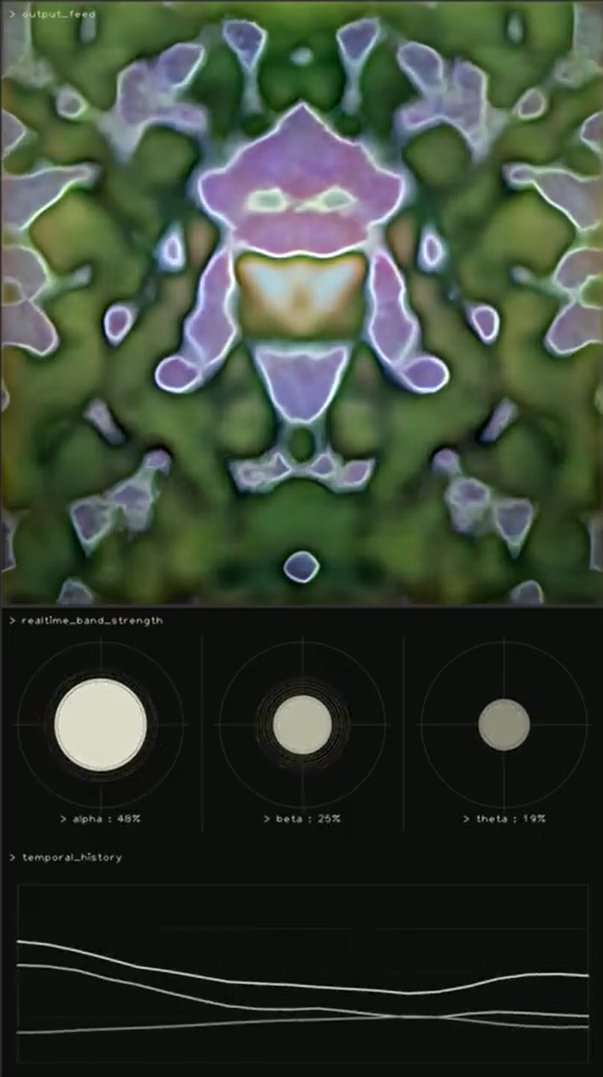
MU is a brain-to-video interactive real-time system. The participant wears an EEG headset and their brainwaves are read and analysed by the system. This brain data is used to drive the output of an AI model, which the participant observes and thus their brain reacts to. In this way a closed feedback loop is created, where both participant and AI are co-authors of the work. The video reacts in real-time to the participant, and the participant's brain reacts to the visual element. The title MU is a reference to Douglas Hofstadter's Gödel, Escher, Bach, which introduces the concept of strange loops. Strange loops are a self-referential system that is suggested to be the basis of intelligence, and the MU system is an instance of a human-AI strange loop.
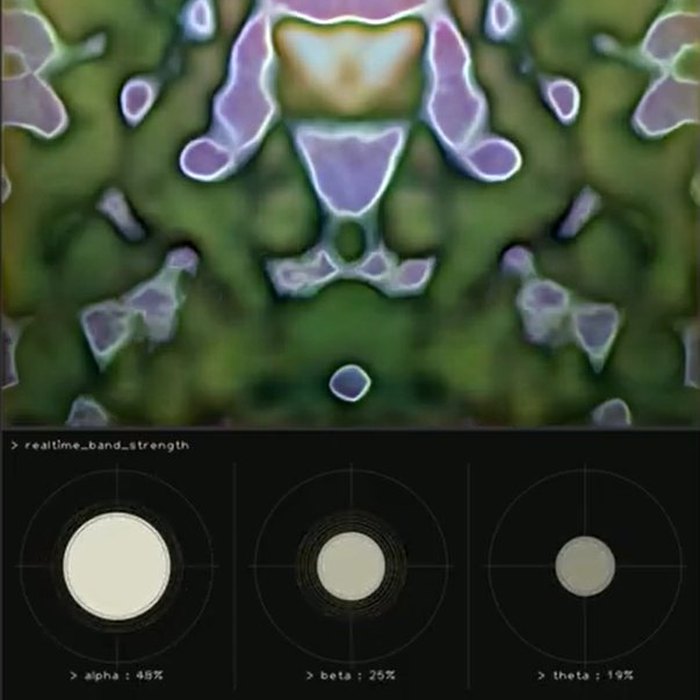
MU is an interaction between a brain-computer interface (BCI), which is achieved with an EEG headset, and an AI model, in this case a generative adversarial network (GAN). The GAN is pre-trained on a dataset of flowers for this work, although for other variations this is different. The brain data read by the EEG is analysed and processed to give brainwave band data. Each band is assigned to a point in the GAN's latent space, and the relative proportions of each band drive a smooth latent space interpolation between these points as the participant's internal processes change over time, which results in the video which shows the output of the GAN in real-time and the corresponding brainwave inputs. The participant is not given any particular goal when interacting with the system, just to observe the video, although it is suggested they might meditate, let their mind wander, or try to influence the video in a certain direction. A feedback loop is formed whereby the video and the participant's brain are linked.
Alex Whelan
Alex Whelan (Aphynia) is an artist and researcher exploring duality in form and conception through audiovisual research.