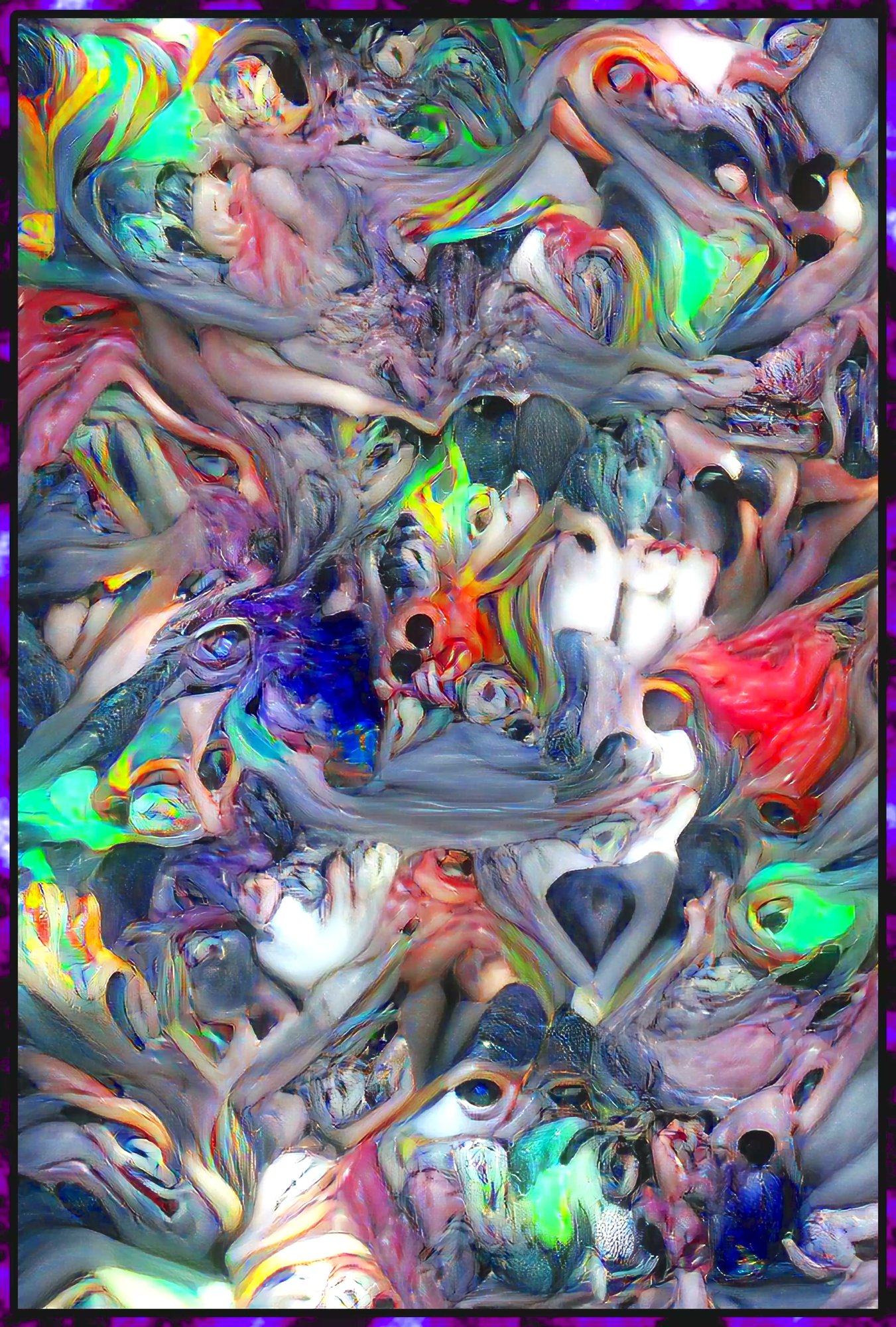
Atay Ilgun, Otherness, 2021/2026. Video + Protocol, 1/1, Courtesy of the artist.
Otherness is a computational artwork concerned with the image as a technology of separation: the process through which an undivided reality becomes divided into things, identities, representations, and selves.
Our relationship to images is, in large part, what makes us human. We break realities too vast to hold whole into discrete pieces, and in doing so become capable of perceiving, manipulating, and constructing the world around us. The image is one of the earliest technologies through which this separation occurs.
The work draws on the Fall as an allegory for this original separation. In leaving the state of oneness, we lose unity, our home in the real, and receive the world in return: a reality composed of distinct objects, subjects, places, and representations. Otherness treats this not as a historical event but as a recurring computational and perceptual condition.
Originally developed through early experiments with VQGAN, the work emerged at a moment when generative image synthesis was still unstable, producing unexpected artefacts, failures, and ambiguous forms. The image became an investigation into what happens when representation begins to detach from its referent, and when the distinction between source, image, and generated reality becomes increasingly unstable.
The work is structured through three interconnected states: Oneness, World, and Fall. Oneness is embodied by the original image and its video form: a singular computational state before its subsequent differentiation. World emerges through the augmented-reality layer, where the image becomes a portal through which additional realities are introduced into physical space. Fall is enacted by the protocol, which subjects the image to time, entropy, fragmentation, and distribution.
The three states describe a movement from unity into multiplicity. The image becomes world; the world becomes representation; representation becomes networked fragments. What is lost in this movement is not simply an image, but the possibility of remaining whole.
The work therefore treats representation as both a technology and a condition of separation. To produce an image is already to fall: to exchange oneness for a world.
Otherness consists of three interconnected computational layers: Oneness, World, and Fall.
Oneness is the original generative image, produced through early VQGAN experiments using source imagery and latent-space generation. Multiple generations, parameter variations, artefacts, and failed outputs were iterated and selectively combined into the final image, which is rendered as a video.
World uses the video display as an AR reference point. The AR system tracks the display and viewer/environmental context to register additional digital layers within physical space, extending the image beyond its screen.
Fall is a time-based protocol applied to the original image. The image is the initial state; elapsed time and the history of previous transformations are its inputs. At defined intervals, the protocol selects and fragments portions of the image, producing distributed outputs associated with addresses derived from the work's history. The process is cumulative, so the image progressively changes as its fragments are redistributed.
The system therefore combines generative synthesis, augmented reality, and procedural transformation within a single computational structure.
Atay Ilgun is a London-based artist, curator, and creative technologist exploring the cultural and aesthetic implications of AI, blockchain, and computational media. Working across image-making, protocol design, software, installation, and sound, his practice examines how emerging technologies reshape perception, identity, value, and systems of reality. His work Realiti (2019), one of the earliest AI artworks minted on Ethereum, was included in Sotheby’s Contemporary Discoveries.
Ilgun has held a curatorial role at IKLECTIK since 2020, contributing to experimental programmes spanning digital art, sound, and technology. His work has been presented at CVPR and Sonar+D.
In 2026, he founded soft world, London.