
1 / 12
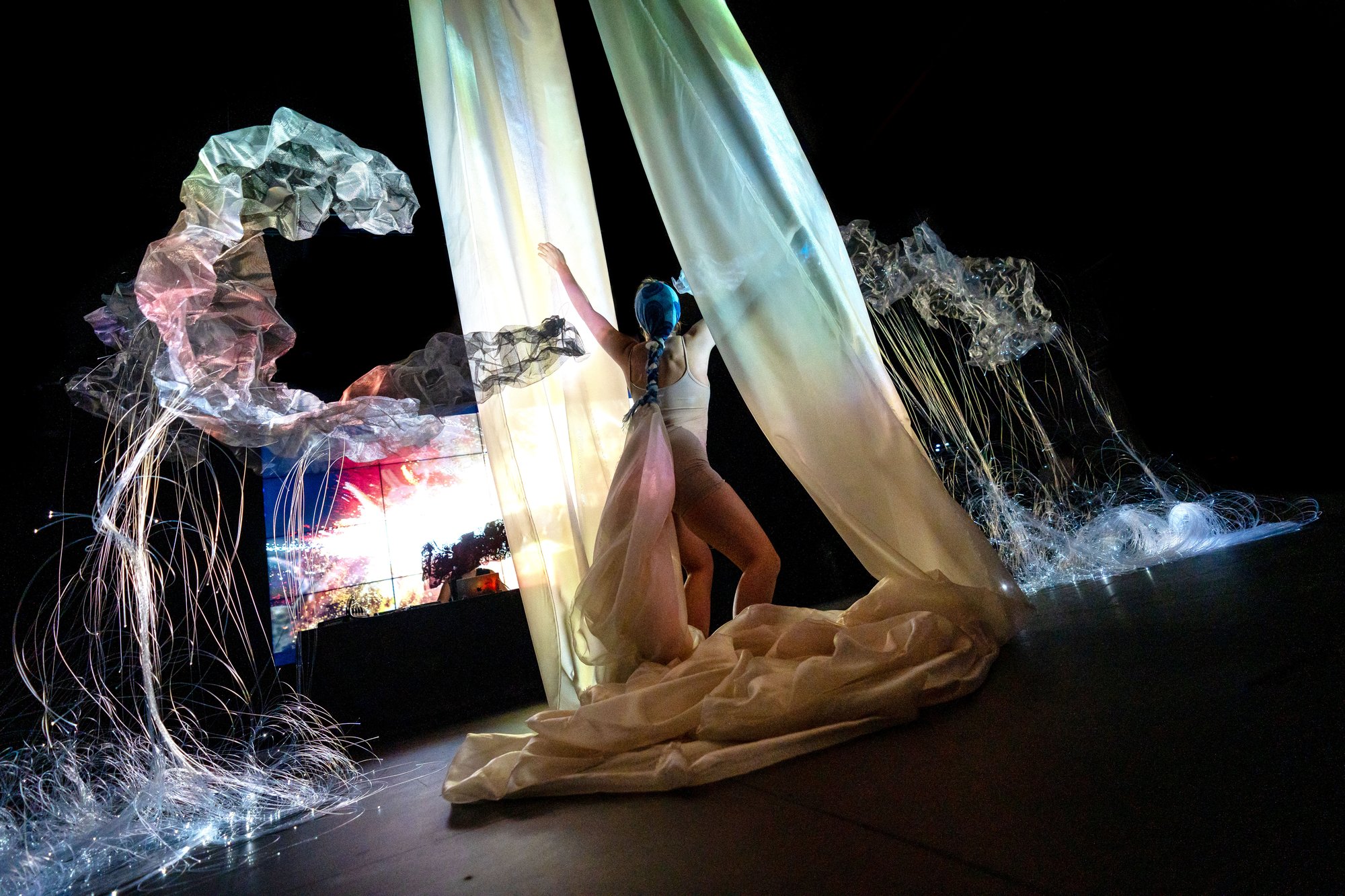
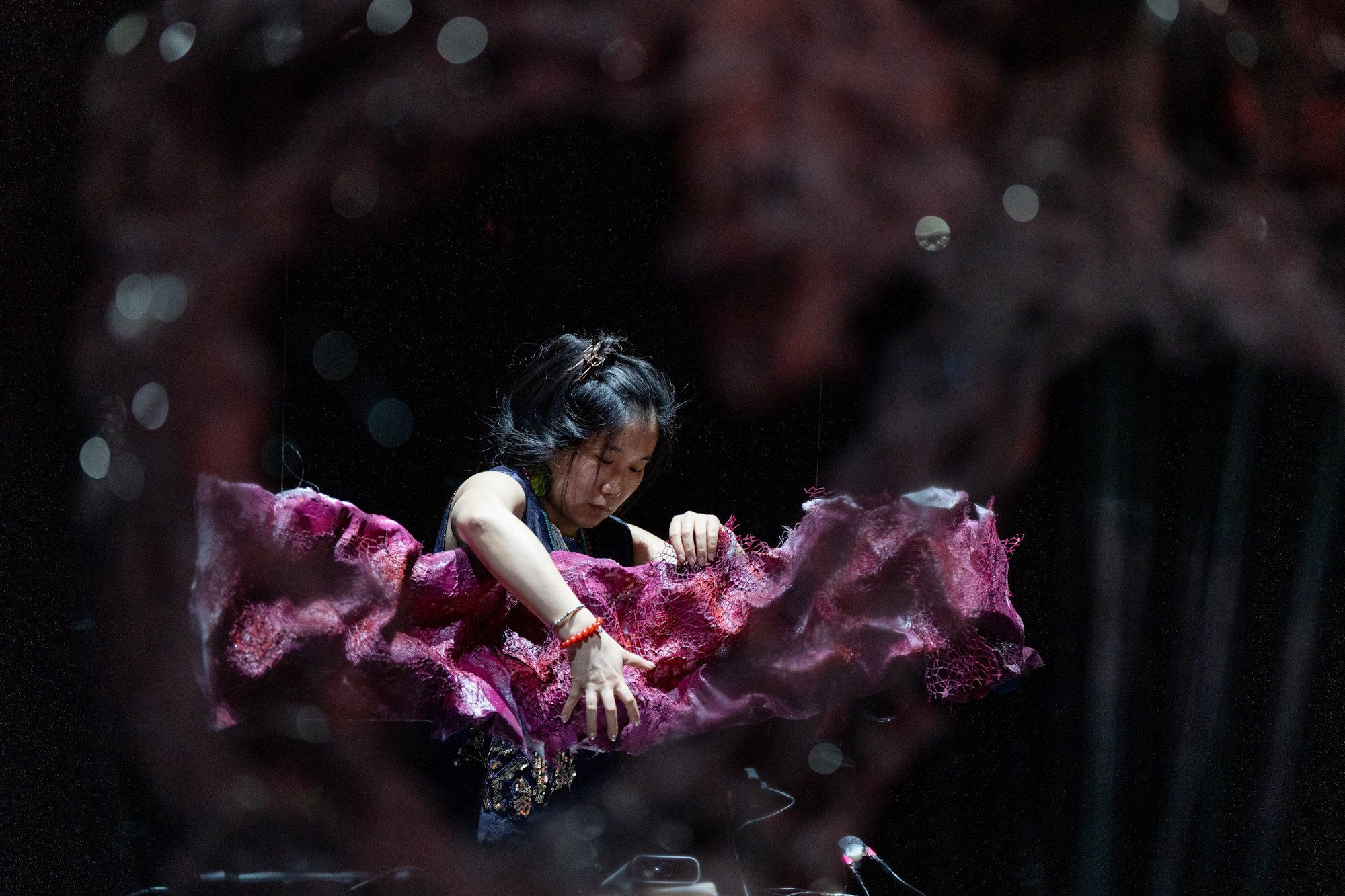
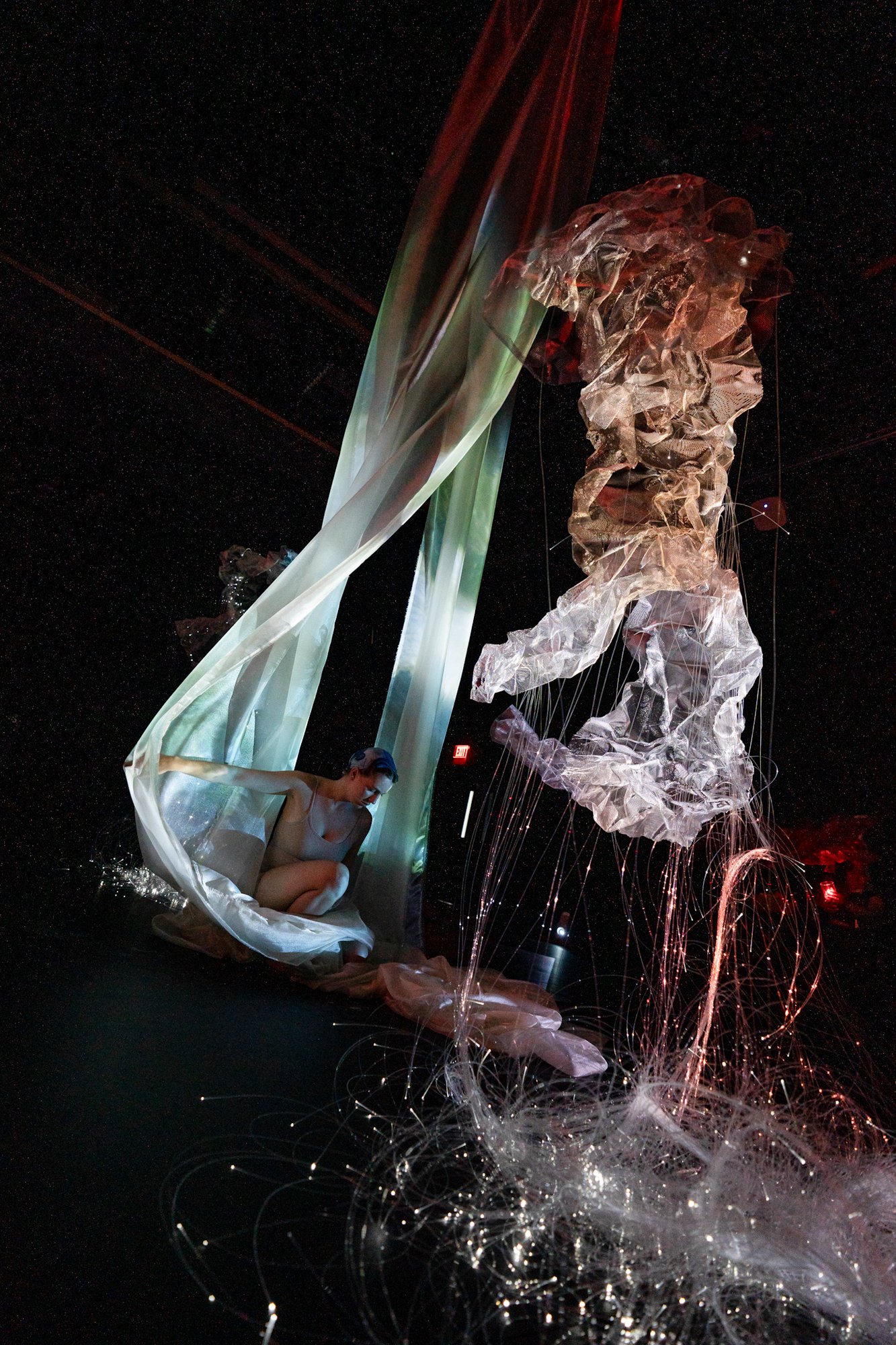
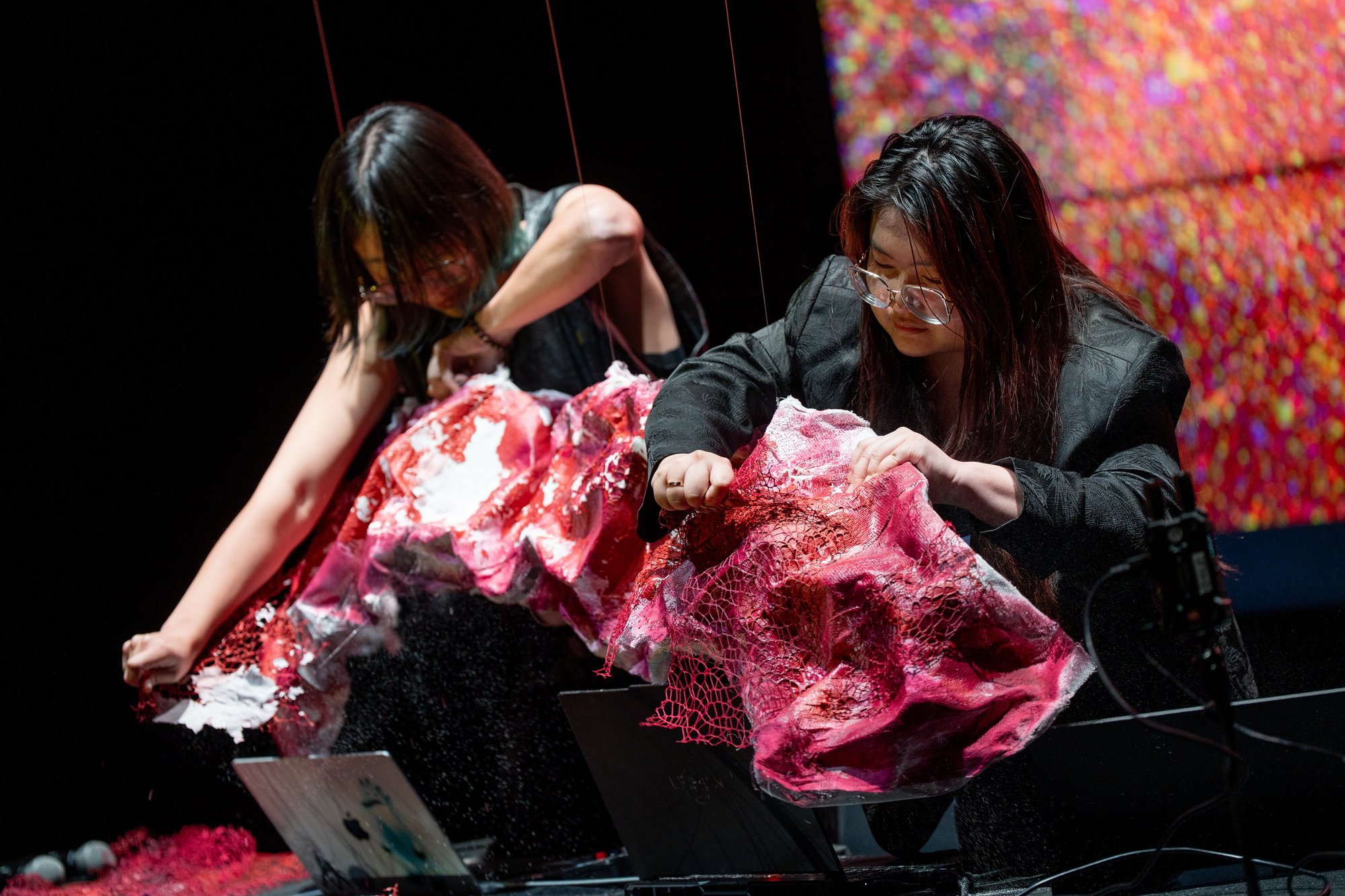
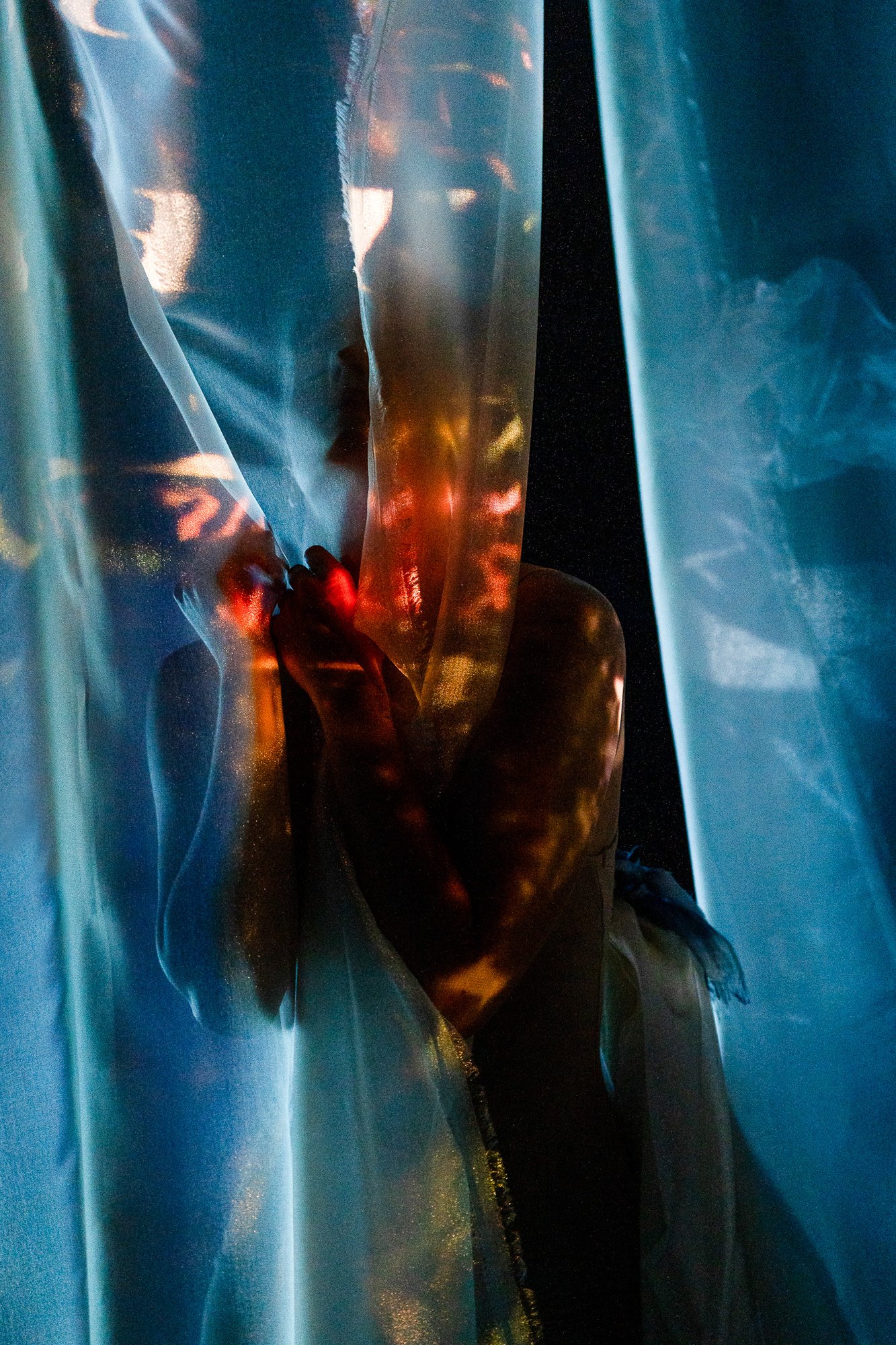
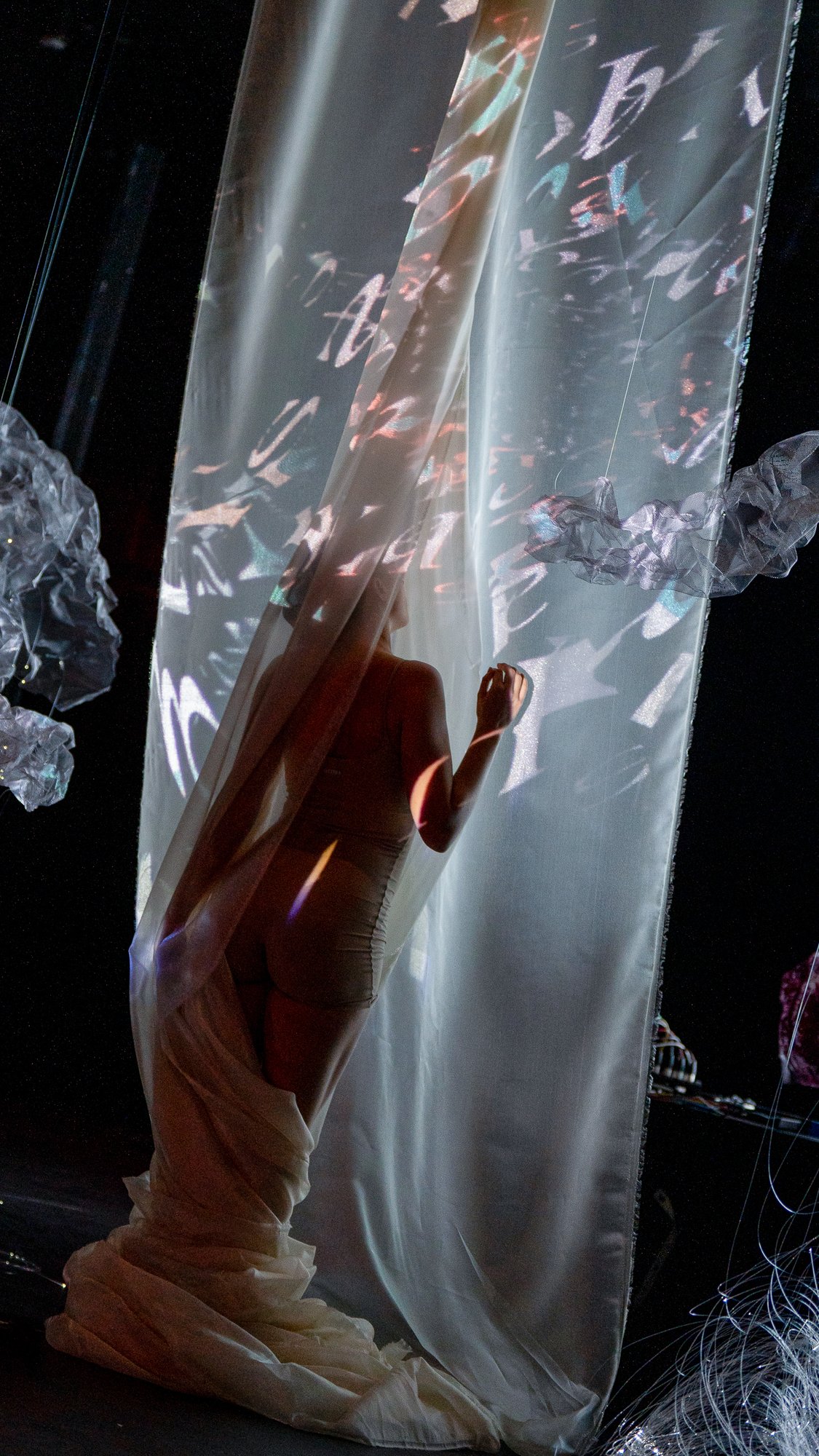
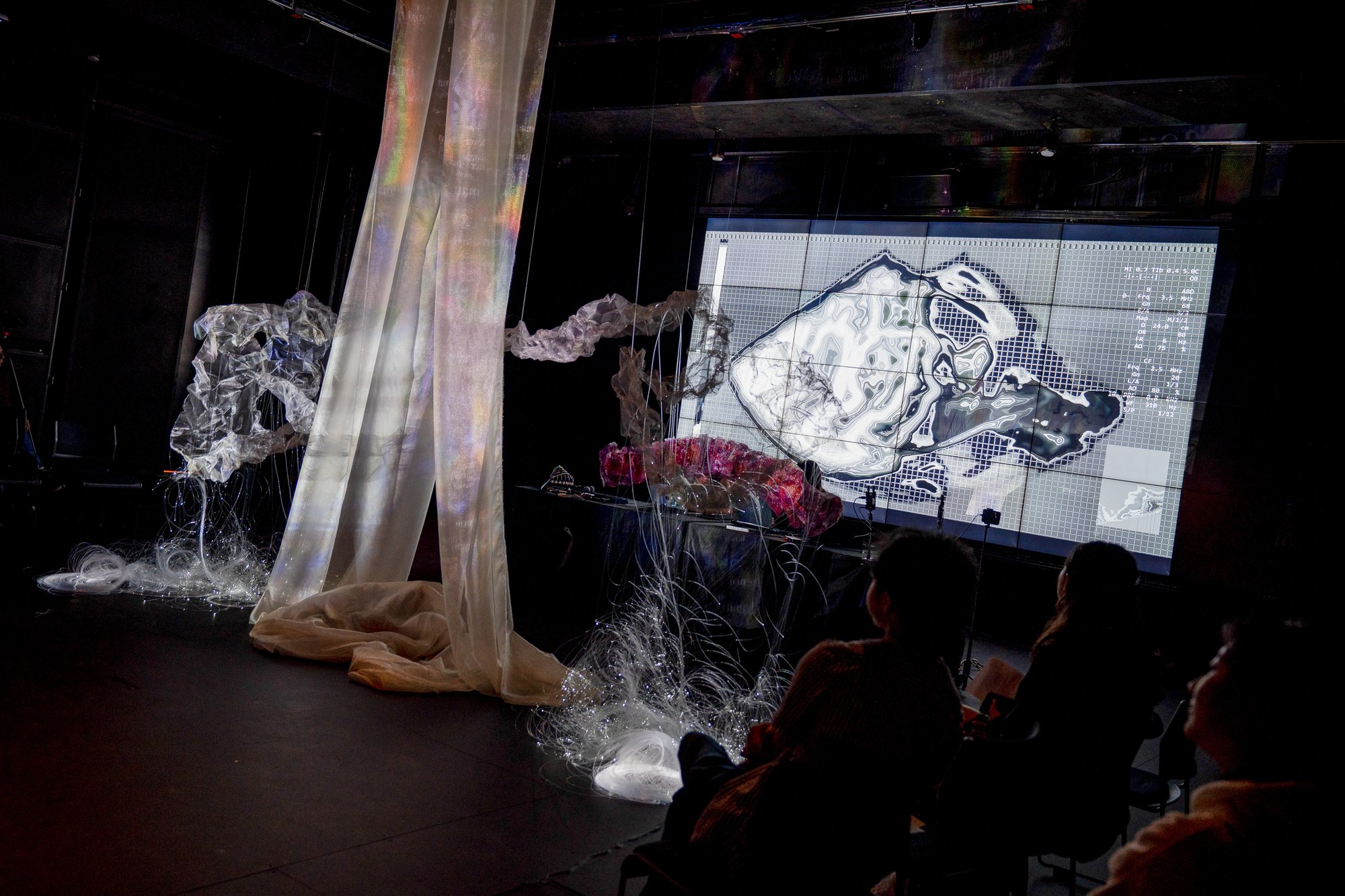
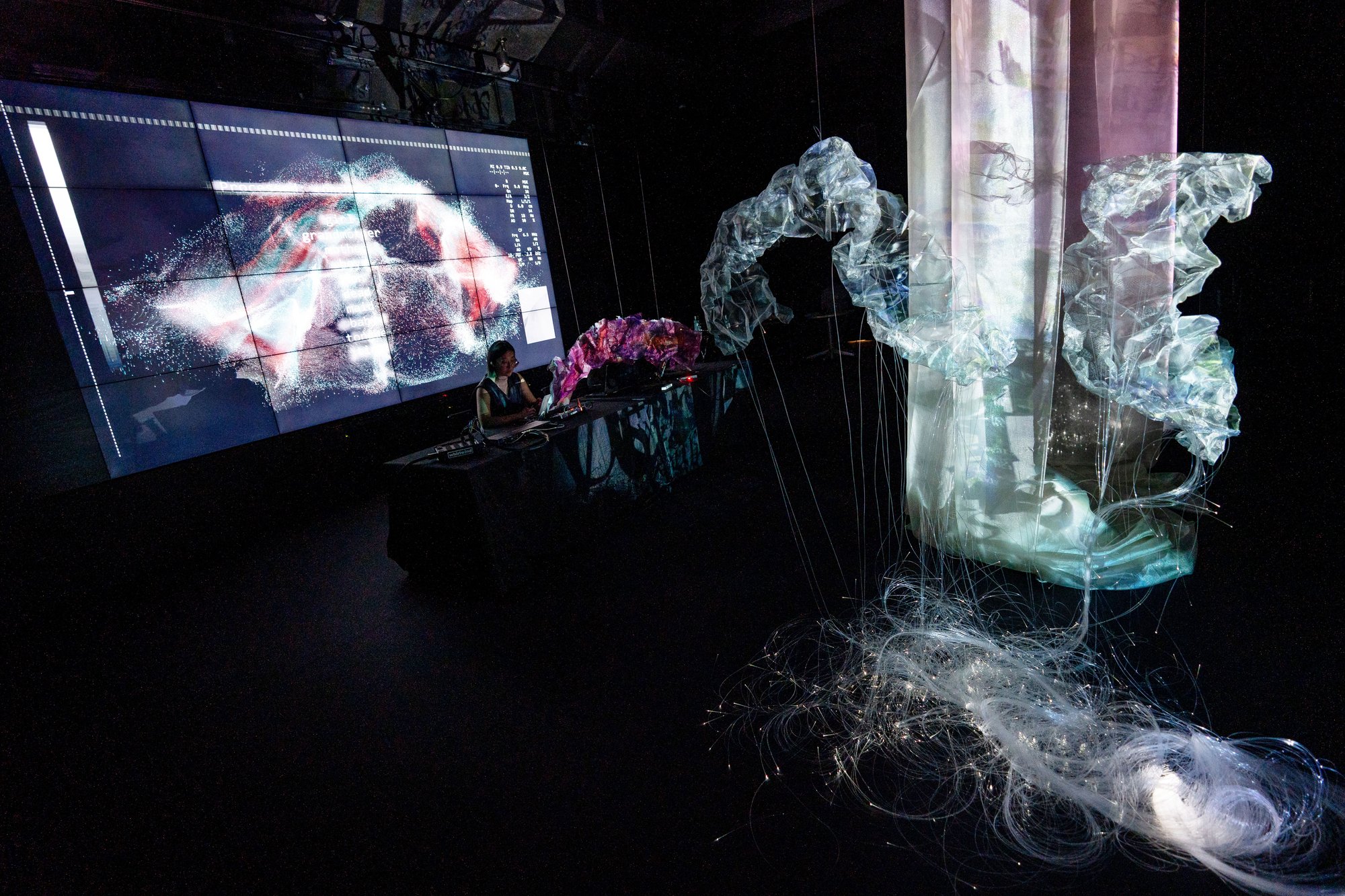
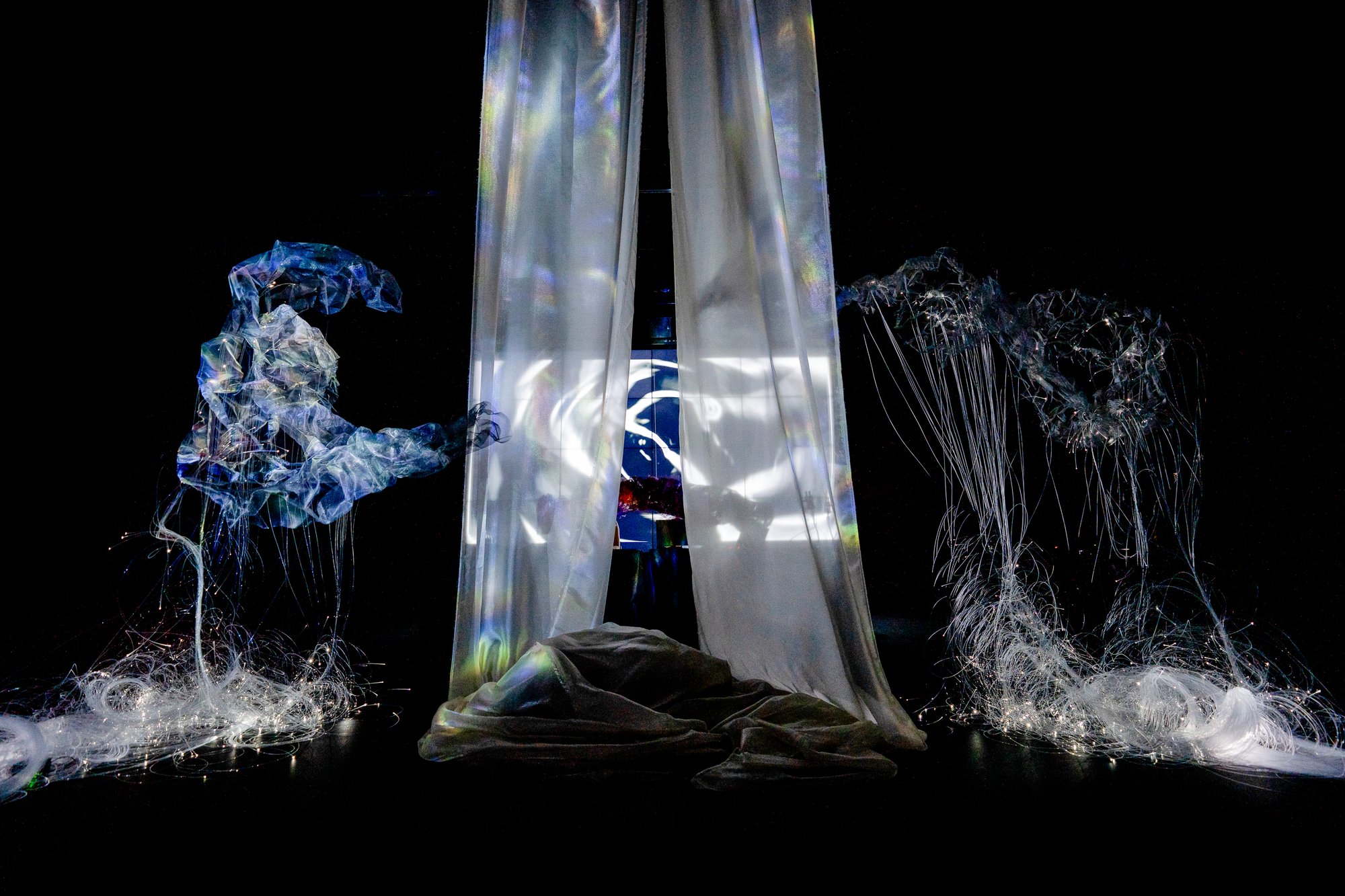
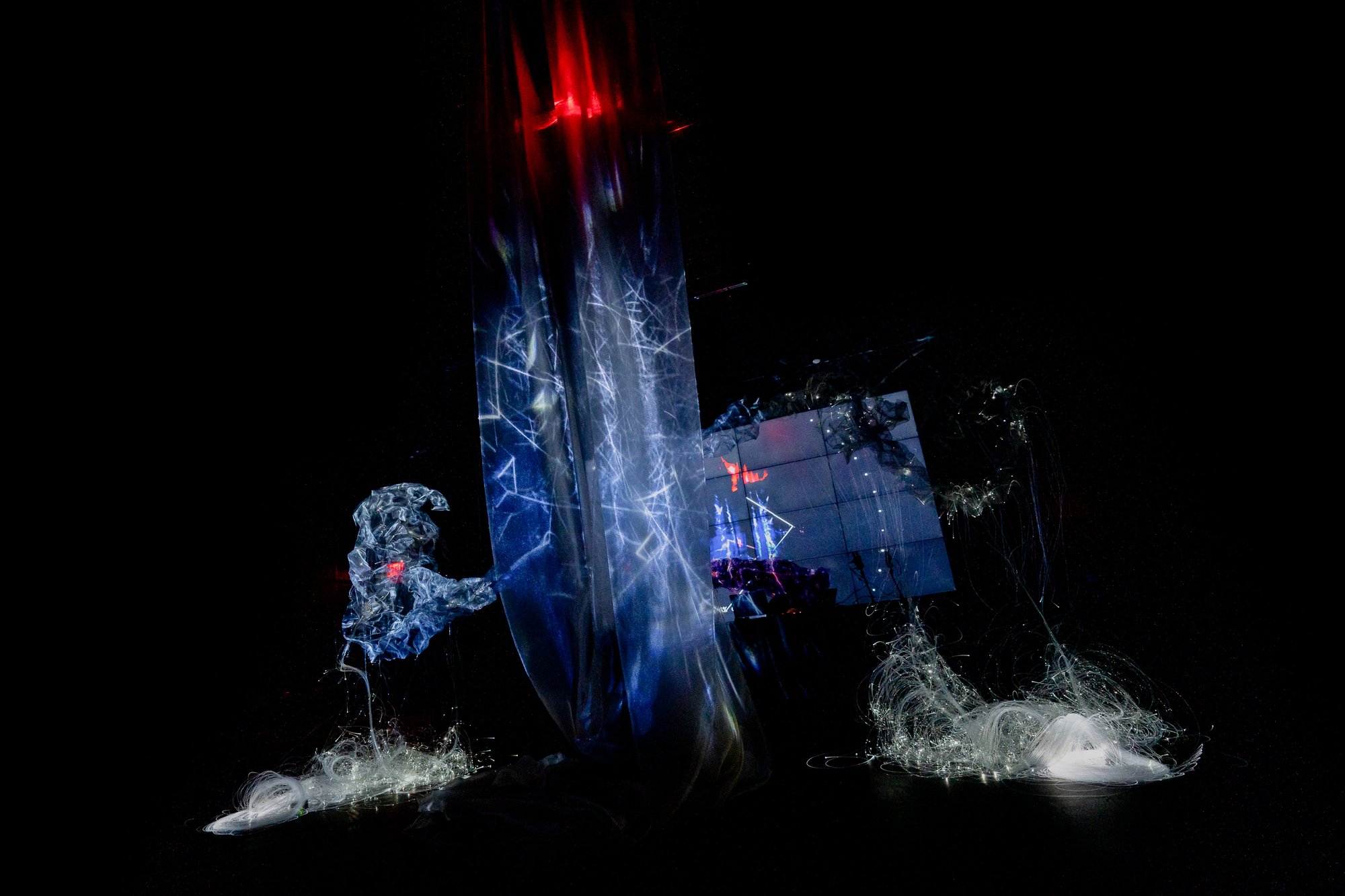
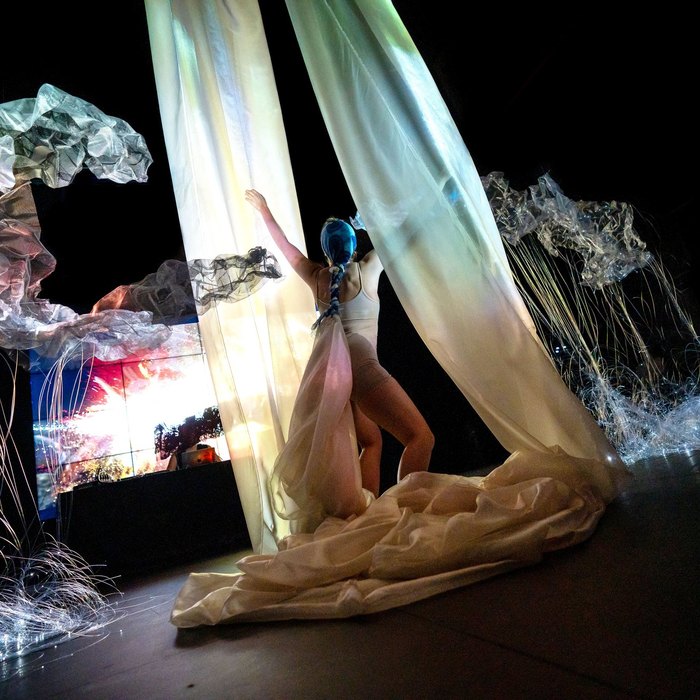
A dancer reaches into a hanging panel of sheer fabric and the fabric takes her arm. Around her, crumpled translucent shells and cascades of filament spill toward the floor. She is almost never seen whole. Nearby, a hand presses an endoscope into folds of cloth, working the camera the way a technician works an ultrasound probe. What that camera sees, a classifier turns into a word; anchored to woman in a word-vector model, the word returns a list that goes up on the LED wall at the scale of the room — creature, monkey, shark, killer, spider, eyes. She keeps moving. The list keeps changing.
Computer vision uses recognition to mean assigning a label. Everywhere else it means being acknowledged. Peeling Cycle is built in the distance between those meanings: a system can see you clearly, name you fluently, and still be wrong, and the fluency is part of how it goes wrong.
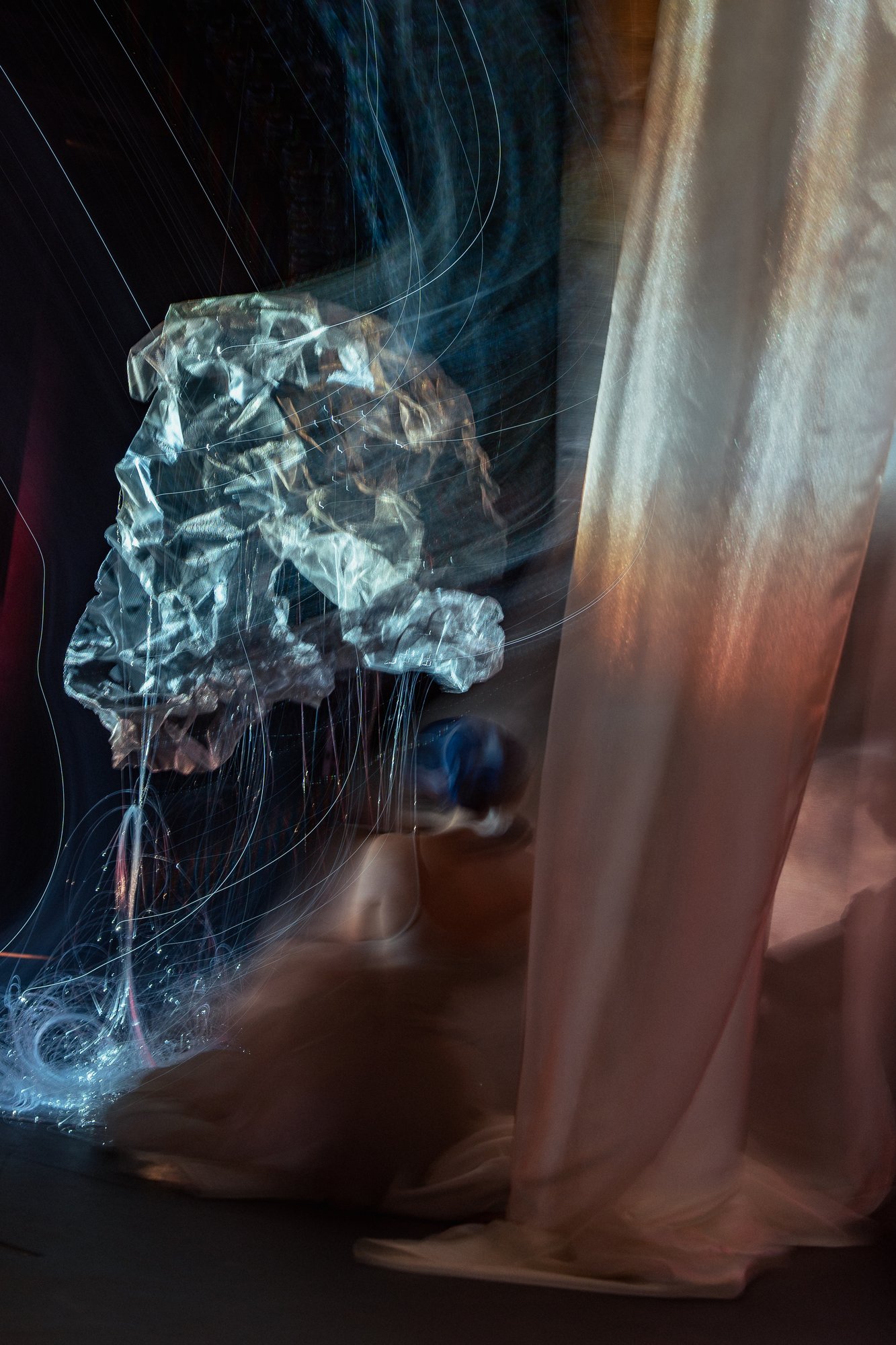
The installation makes looking difficult on purpose. Membranes and sheer panels stand between the audience and the dancer, so you get her in fragments, which is roughly what the cameras get. Movement does the rest: classifiers want one object held still and seen whole, and a dancer offers the opposite. We run the models slightly outside where they work — the classifier's tenth-ranked label rather than its first, the detector aimed at abstract laser light where there is nothing to detect — so what returns are the categories they reach for on their own.
Into that we feed short fragments from our own lives, written in Chinese and translated to English before the model sees them. A private memory comes back as a symbolic object, and the object becomes the picture.
The three of us are Asian immigrant women working in technology. The work draws on research into inherited bias in language and vision models and on Atanasoski and Vora's surrogate humanity. Four scenes carry a life from enclosure to exposure; in the last, three of us tear the outer membrane off the structure by hand, red transfers onto skin, and the system stops running.
Peeling Cycle is a live audiovisual performance implemented as a real-time, strictly feed-forward multimodal pipeline across two networked machines — TouchDesigner for vision and compositing, Ableton Live for audio. Inputs are all live: an endoscopic camera handheld inside a textile enclosure, a breath microphone, and a second camera capturing the ceiling projection of a DIY laser instrument (red emitter, Arduino-driven motorized gobo, refracted through handheld glass). One authored input, a curated corpus of memory fragments written by the three performers, enters at the prompt stage. Outputs are a projected real-time composite, synthesized speech in a cloned performer voice, breath-driven sound design, and on-screen display of intermediate machine state.
The endoscopic feed runs through an image classifier from which we take the tenth-ranked label rather than the argmax, sampling the tail of the distribution. That label is combined with a fixed woman anchor in a custom real-time GloVe-6B module (binary-serialized for live lookup) whose ranked neighbours drive the visuals. Breath is classified into respiratory phases by filterbank spectral analysis. A YOLO11-Nano workflow reads the laser feed — a deliberately off-distribution application in which unstable detections are treated as generative material — and queues labels, boxes, and confidences over time. Queued detections plus a memory fragment are merged into an LLM prompt with a strict two-field contract: one interpretive sentence, and one symbolic object whose name is a valid conditioning seed for StreamDiffusion-TD. The sentence is voiced by TTS and mixed live; the generated image is composited with the laser feed.
Nothing is retrained during performance and no output updates any weights. All intervention is output-level. In the final scene the pipeline is deliberately withdrawn and the sound becomes the direct noise of the set being torn apart.
Hailed as "superb" by The Wire, Anqi Liu is a composer, interdisciplinary artist, photographer, and filmmaker working across composition, free improvisation, electronics, modular synthesizer, Mongolian choor khuur, and audiovisual ecologies. Boomkat praised her solo synthesizer album; Veiled Erosion (KAIROS) drew wide acclaim from de Volkskrant, critic Peter Margasak, and many others. She has presented at IRCAM, Darmstadt, ICMC, and NIME, among others, with residencies at EMS Stockholm and elsewhere. Born and raised in Inner Mongolia, she originated the Ecology of Fraysonics. Liu is Assistant Professor and Music Production Program Lead at RMCAD, holding a Ph.D. from UC San Diego.
Han Zhang is a multimedia artist, computer musician, performer and engineer based on earth. She actively works on creative projects that explore the new form of multimedia participatory performances with DIY installations that deliver immersive interactive experience and support her theatrical practice. She is interested in discussing the collective comprehension of technology, art, and substantive human lives. In the realm of music technology and engineering, she is interested in exploring the interpretability and controllability of timbre in sound and designing musical instruments that incorporate innovative research results. Han is also an amateur radio technician and a nature enthusiast.
Mingyong Cheng is an interdisciplinary artist, researcher, and creative technologist from Beijing, now based in Atlanta. She works across generative AI, computational media, and immersive art, creating interactive installations, performances, and real-time audiovisual systems combining sensing technologies, spatial media, and machine learning. Her practice treats AI as a creative collaborator shaping perception, narrative, and audience experience, developed through collaborations with curators, choreographers, and composers. She has led commissioned projects for the San Diego Museum of Art and Jacob's Pillow Doris Duke Theater, and her work has been presented internationally at ACM SIGGRAPH, NeurIPS, ISEA, and the IEEE CVPR AI Art Gallery.