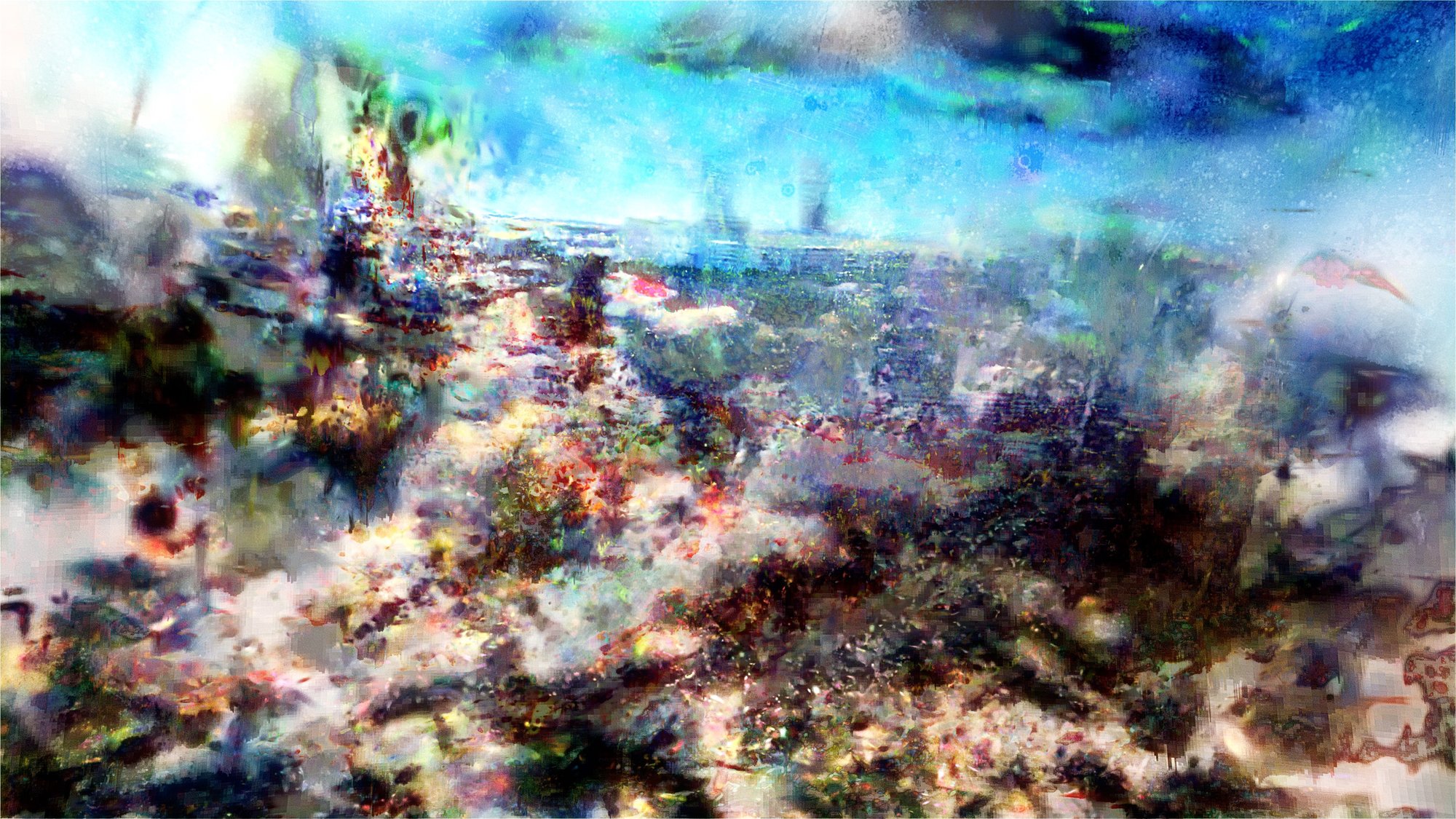
"10-18 @ Parker Center" excavates a fractured urban memory through four-dimensional temporal space, collapsing past, present, and future into a single moment of visual meditation. Grounded in downtown Los Angeles and the symbolic architecture of the Parker Center police HQ, the work interrogates how geography, politics, and cultural memory intersect in a landscape synonymous with cinema, music, and institutional violence. Using digital geographic platforms to reconstruct a 3D gaussian splat field of this view of Los Angeles, I create what functions as a psycho-geographic composition; one that invokes a sensory sense of being there while simultaneously rendering that presence as fractured, obfuscated, and temporally unstable. The work resists seamless representation or any sort of Kitsch associated with many other digital works; instead, it channels the expressive logic of Abstract Expressionism and media archaeology to layer technical artifacts and post-processed interventions into a cohesive visual system that I work on in a filmic timeline. Rather than presenting a singular documentary truth, "10-18 @ Parker Center" proposes that technical manipulation can become a form of emotional archaeology, one that grounds our relationship to contested spaces, hidden histories, and the stories encoded in the places we've inherited, even from afar and how that is portrayed in various medias from songs, books, documentaries and feature films.
The work operates through a multi-stage pipeline that transforms geographic data into a temporally-inflected visual composition, which at each stage allows me to interrogate my artistic thinking and intention, rather than just relying on one point of creation, like much generative and digital art has become.
Captured Input: A gaussian splat is captured via my smartphone, using a freely available app that processes on my device, in this case Scaniverse. The point cloud is derived from a manipulation of digital geographic platforms, Google Earth here, that I attempt to force my smartphone camera to recognise as a 3D object, rather than a flat screen. It's in this disconnect that certain geometries are captured, but not necessarily cohesively. Plus it’s very hard to do with one hand on the phone moving around, and the other hand on a mouse and keyboard moving around the geographic landscape. Data Transformation & Processing: The point cloud is imported into post-processing software where layering, temporal compression, and deliberate artifact retention occur, techniques that I borrow from my advertising and film background that help introduce expressive distortion. These geographic datasets are ensemble'd, layered and fractured, creating discontinuities that resist any photorealistic reconstruction, but still try and capture an idea of the subject.
Conceptual integration: Rather than smoothing data into seamless 3D geometry, which the apps do very well, the technical process preserves artifacts and lack of coverage: compression noise, sampling gaps, coordinate uncertainties. These become formal elements, analogous to brushstrokes or color blocking in painting, which i can then mix with numerous other types of medias, from paint strokes and marks, photographic textures and emulations of other media captures, like film grain, chromatic aberrations, vhs scanning, mathematical noises and halation.
Output: From my filmic timeline i can output to various stills or time-based compositions where the technical limitations and data imperfections function as evidence and traces of the capture process itself which i hope anchors the viewer in the material reality of how we now access and reconstruct geographies through algorithmic mediations.
Michael Woodruff
nectarmotion.com · Instagram · michaelwoodruffcouk.wordpress.com
Michael Woodruff is a London-based digital artist working with animation and motion design. Drawing from Abstract Expressionism and decades in film and advertising, his practice explores how memory and emotion are shaped by medias. As a Techspressionist working with archival footage, scanned textures, and system-based processes, Woodruff excavates the emotional logic of media decay and rebuilding analog imperfections like film burn and VHS artifacts as deliberate formal elements. His time-based compositions interrogate our relationship to the past in an age of seamless reproduction, creating visual systems that feel haunted by the technologies that shaped us.