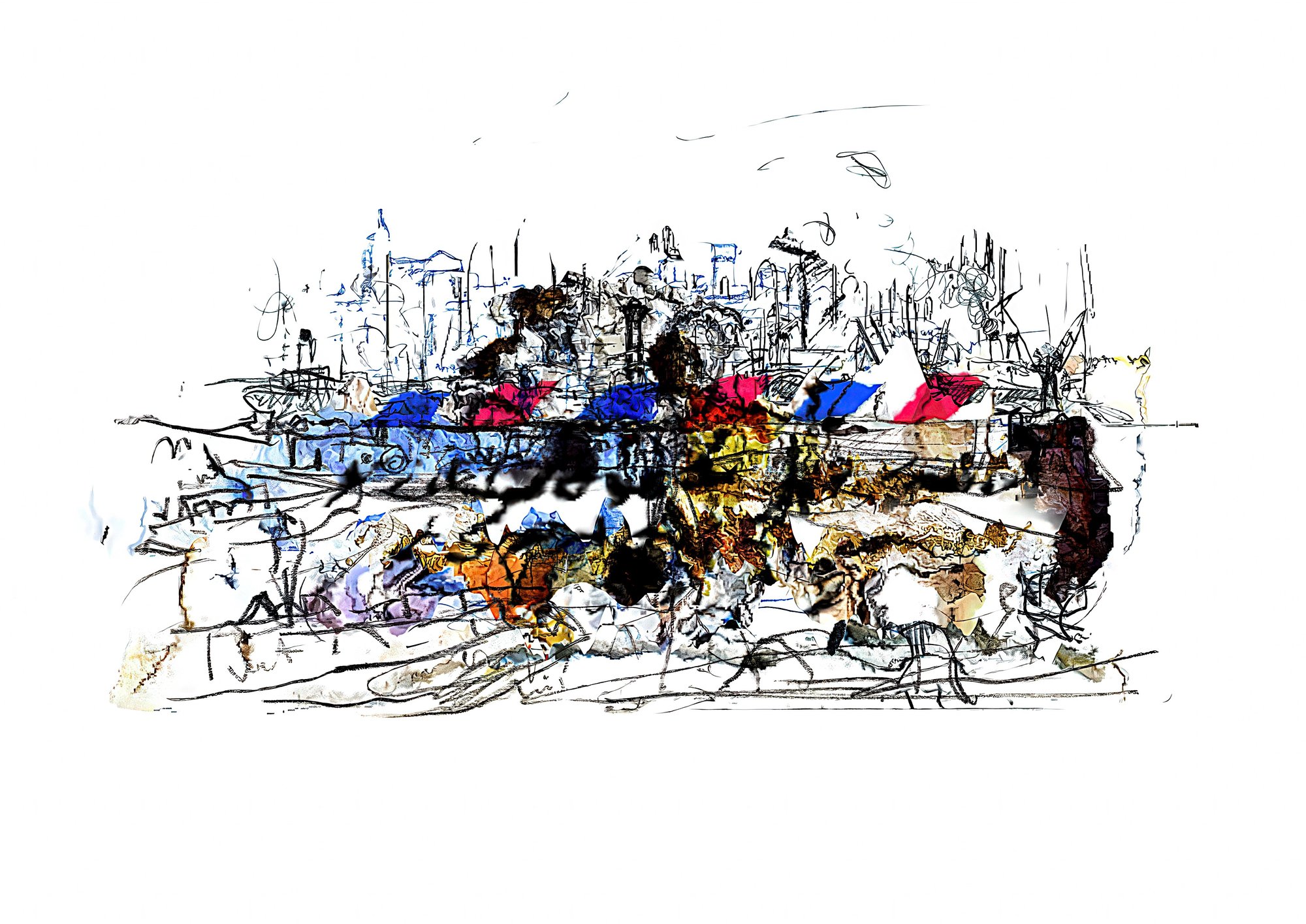
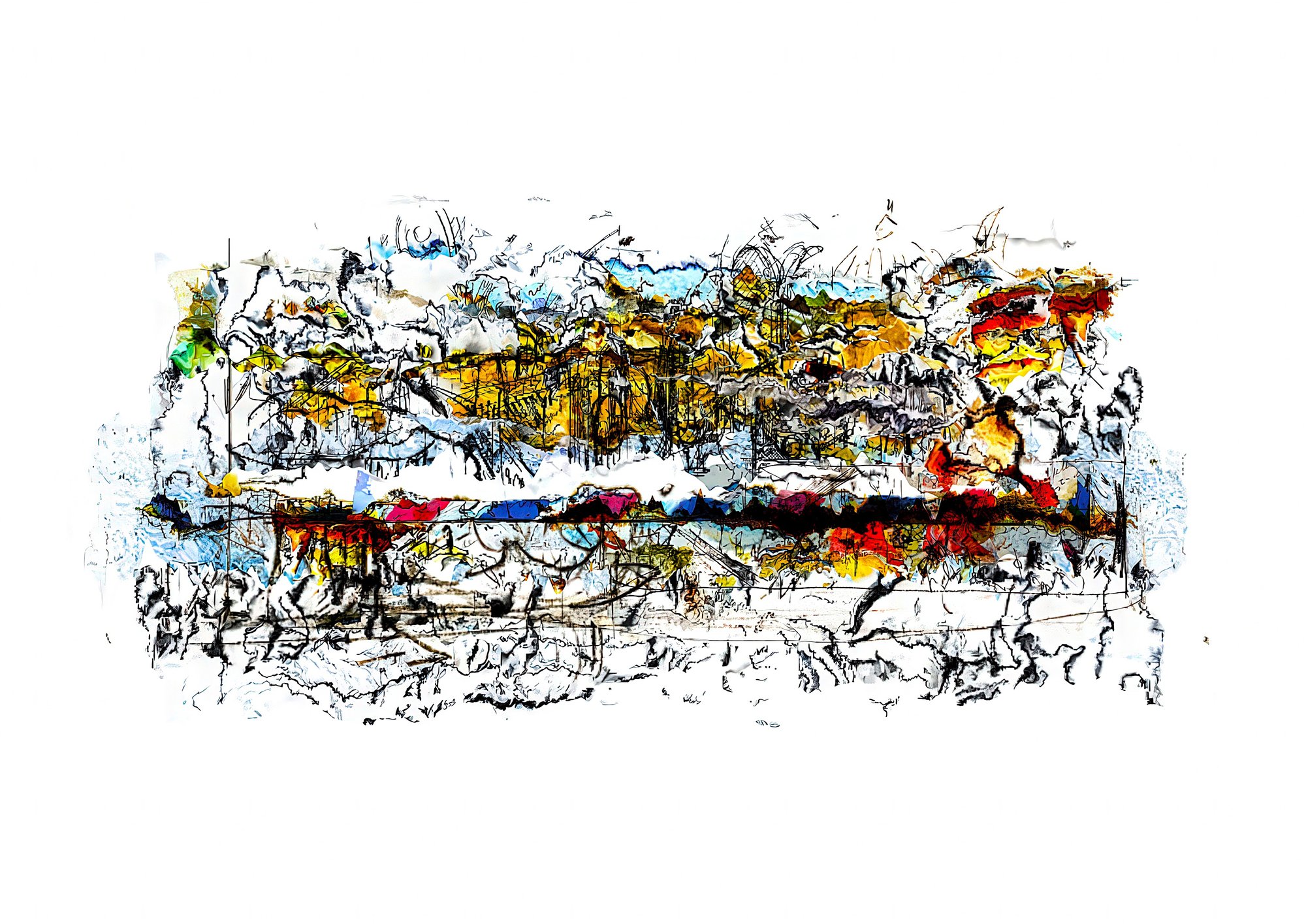
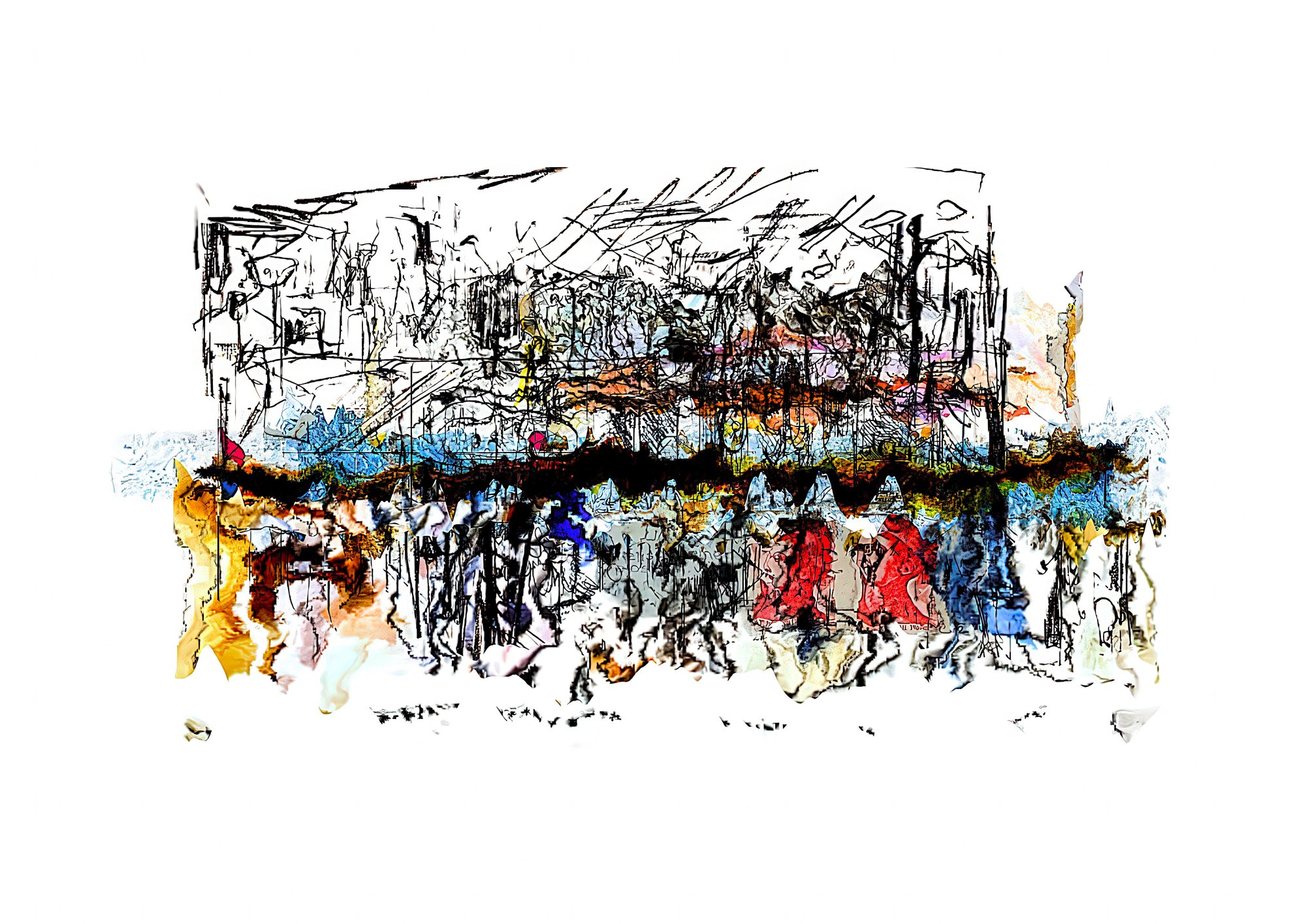
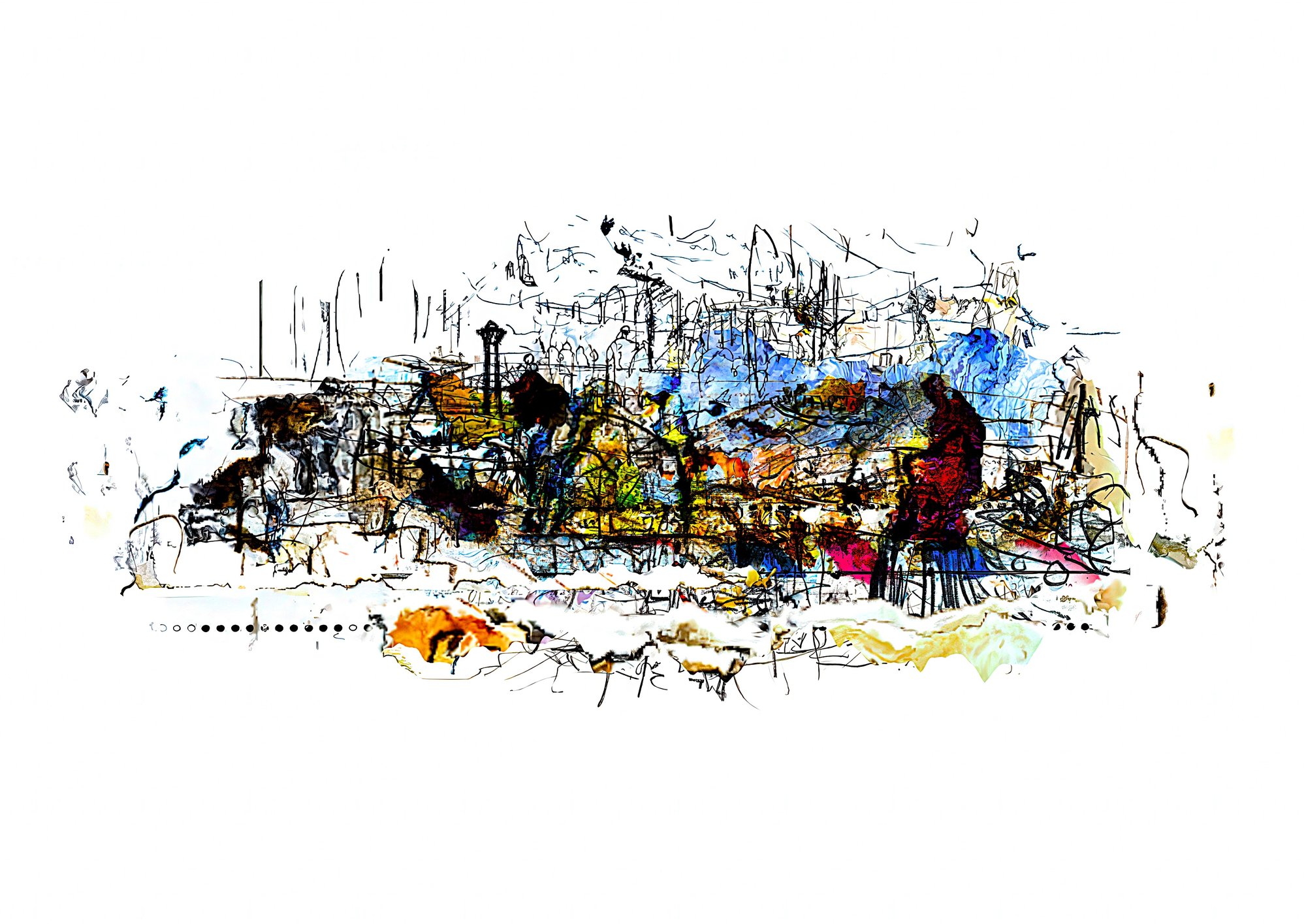
Same caption for all 4 artworks: Digital sketches mixing custom code and machine logic workflows with digital edition, drawing, and collage. © 2026 Miguel Ripoll. 1 / 5
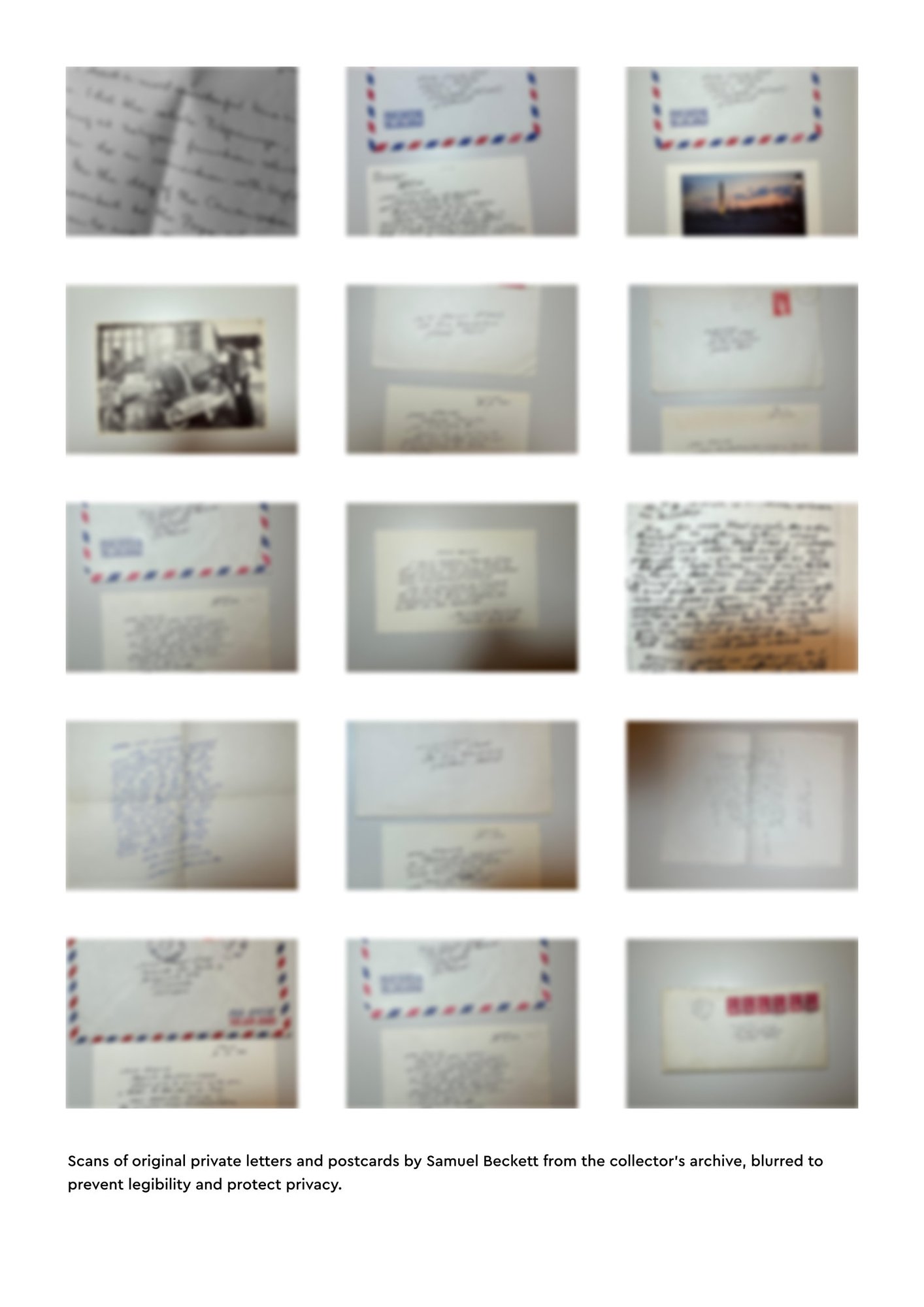
This project is based on a private archive of unpublished postcards and notes by Samuel Beckett (used here under written license from the collector who now owns them), which will be exhibited alongside the new works, but displayed behind frosted glass: only the front images of the postcards will remain visible, while the handwritten texts on their reverse will stay illegible and private, as they have always been. What is engaged with is the postcards' front images, the digital trace of Beckett's handwriting as statistical data, and the paper itself.
A series of manually crafted post-figurative works on paper, sculpture, and code that mix custom code and machine logic workflows with digital collage, hand-drawing, robotics, and traditional craftsmanship and materials (cotton, wood, copper, iron, silver, jute, wax, silk).
Premise. Beckett was the twentieth century's great alchemist of linguistic reduction, stripping language to its essential minimum, exploring silence, absence, and what remains when everything inessential is removed. This correspondence reveals that the same process applied to the briefest possible transmissions. They represent the extreme end of his reduction: language at absolute zero, the barest acknowledgment that communication still functions. They are not literature. Almost nothing remains. This project begins where Beckett's reduction ends.
Concept. Beckett wrote almost all of his famous first drafts by hand in notebooks using ink and crayons, and later typed them on a typewriter, at the dawn of mechanised text, finding a way to make work that survived the machine of his moment. This project works with machine logic at the moment when text and image are processed by statistical systems whose internal logic no human fully understands. Both processes are about what survives reduction: Beckett's, by hand and typewriter, draft after draft until almost nothing remained; this project's, by reducing what was already minimal a second time, with the machine in between.
The work asks what survives, of human presence and human language, when it passes through the machines of our time. Beckett understood that silence and absence are not the opposite of language but integral to it, and his work operates in the gaps, the pauses, the censored and unsaid. The question this project proposes lies in friction: the typewriter that requires correction, the algorithm that requires curation, the choice to make the mark, on paper and wood that have outlasted centuries.
Process. High resolution scans of the postcard images, the letters, and the envelopes, (including stamps and postmarks) are treated as objects, the hand-writing as mere spatial and statistical data, Beckett’s texts never read or reproduced. Custom code and machine logic iterative workflows process, map, transform, and break the documents into post-digital fragments, no prompting, no style references. I curate what survives and then edit, remix, and collage those fragments digitally, mixing them with my own digital drawings, then transfer the images to hand-made archival papers, break them intro scraps, draw over them by hand, in ink and mineral pigments, and stitch them together with copper and iron wire, silk thread, and jute cord. All digital files are then deleted and only one unique, unalterable physical artwork remains.
Paper and wood are hand-crafted from a single 350-year-old French oak, a tree already two centuries old when Beckett was born. For the sculptural pieces, the same fragments are reworked dimensionally in paper, wood, jute cord, and silver. Each stage leaves residue. The final work is the archaeological record of all of them.
Small gestures that confirm: the human hand was here.
Miguel Ripoll
Miguel's work predates "AI art" by decades: his early pieces, shown at the Reina Sofía Museum and the Cervantes Institute, are now in permanent collections like the Design Museum in Barcelona. He has presented at CVPR in Seattle (2024) and Nashville (2025), at the RAK Biennial (UAE), and in group exhibitions in Berlin, Hamburg, Palermo, London, Cork, São Paulo, Belo Horizonte, and Miami, plus museum shows in Italy, South Korea, and Morocco (solo tour 2025-2027). He was a finalist for the 2025 KANE Art Prize in London, and for the 2026 Digital Art Awards at Phillips (curated by HOFA Gallery).