
1 / 12
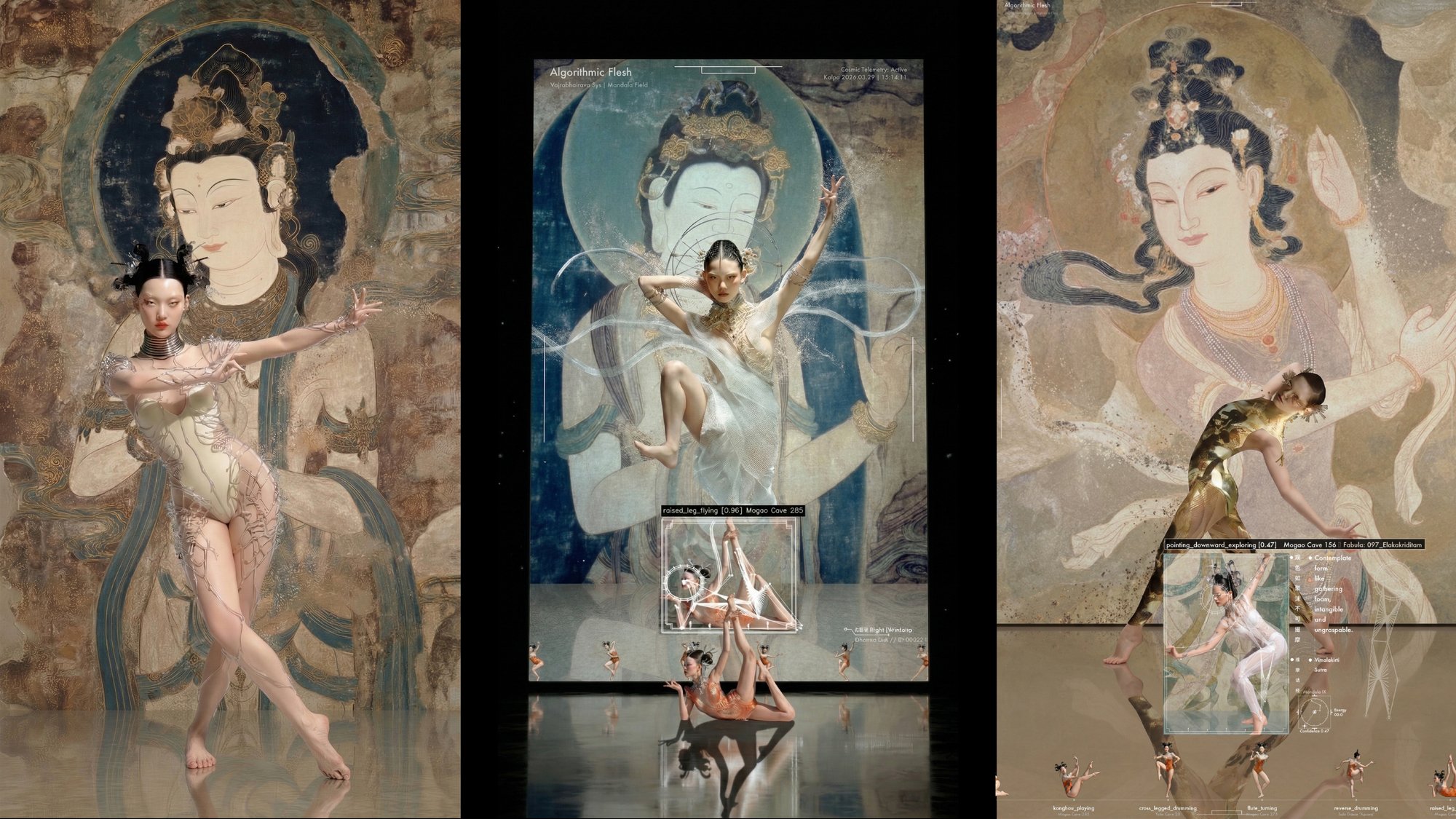
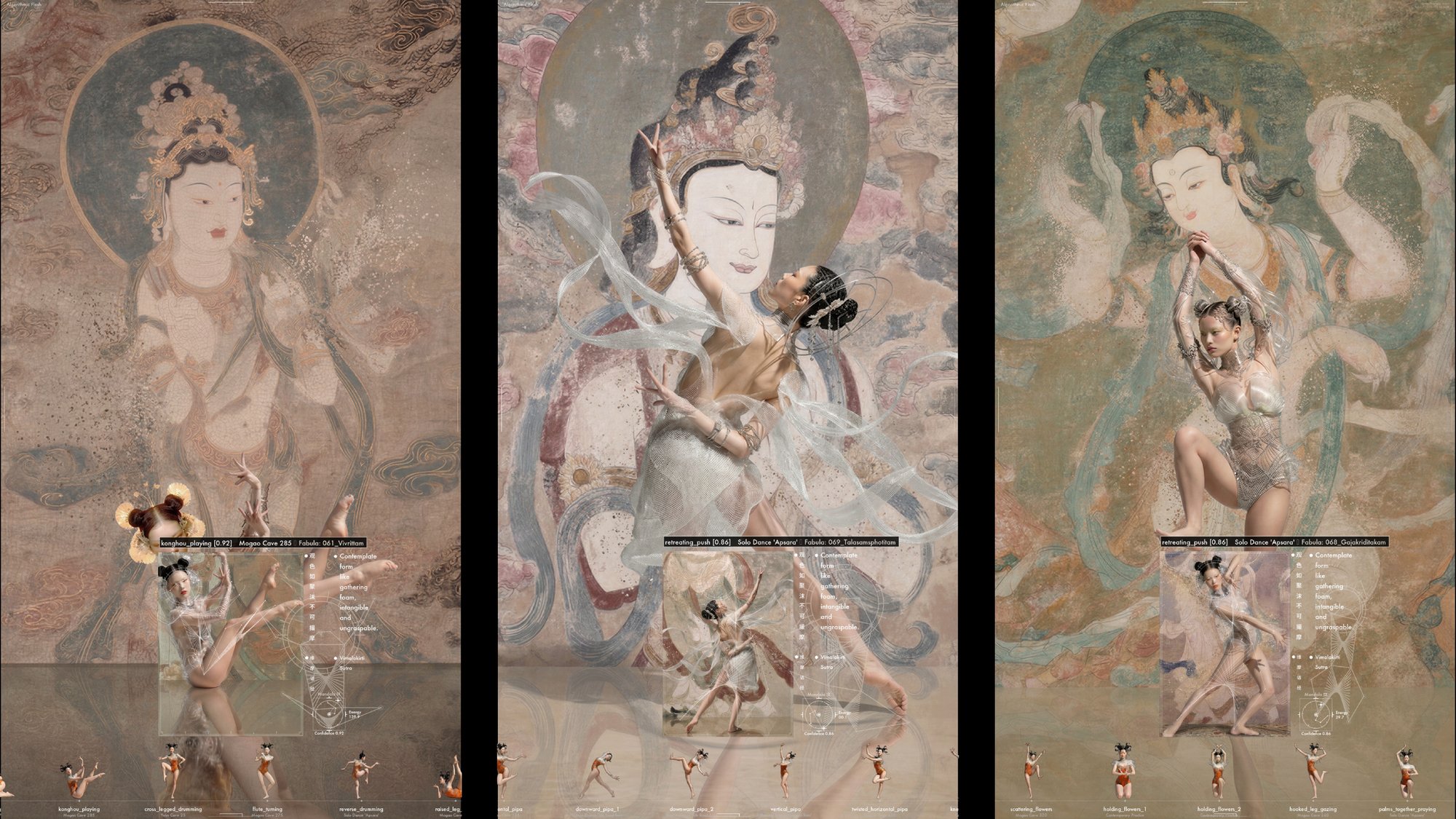
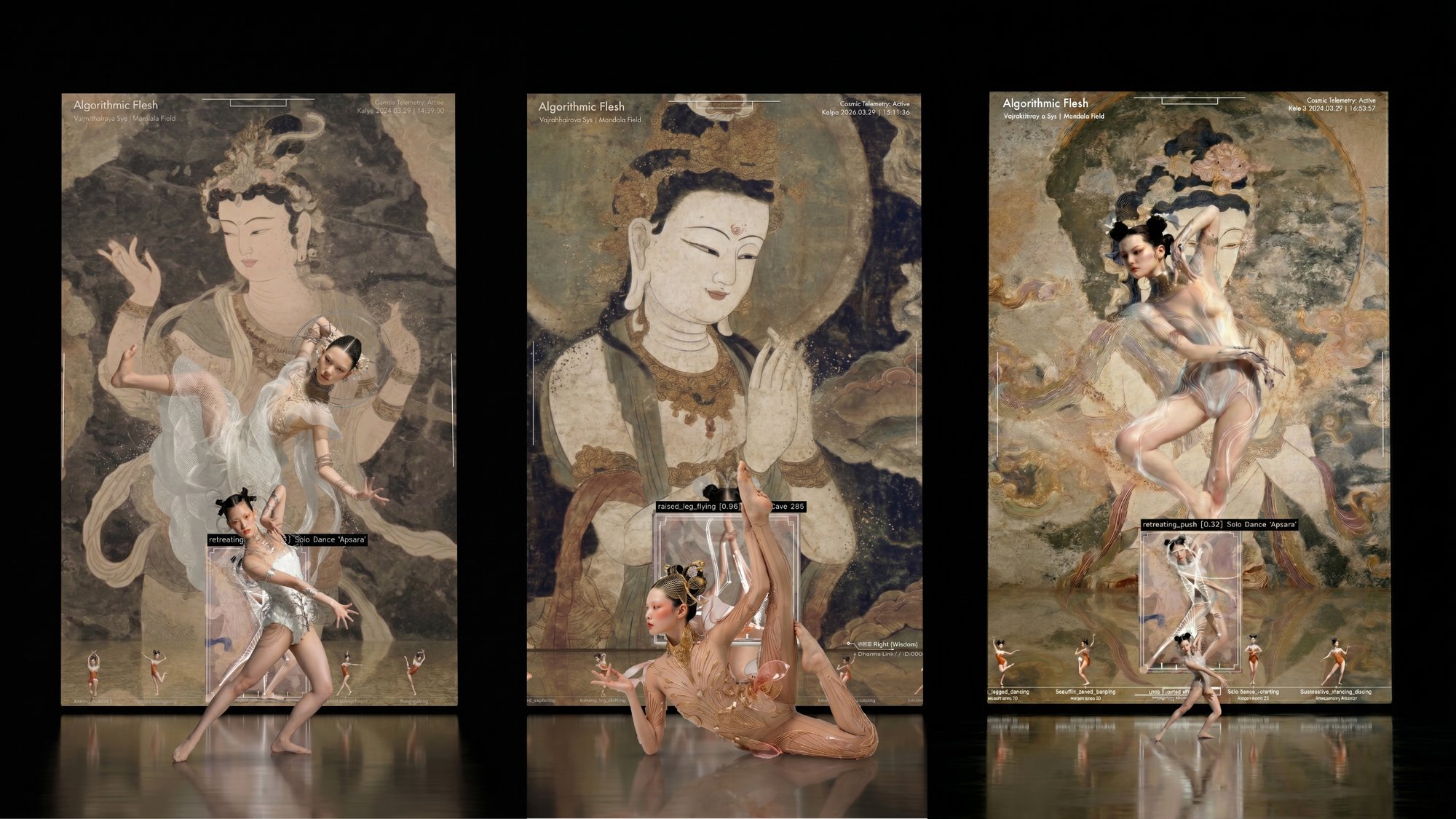
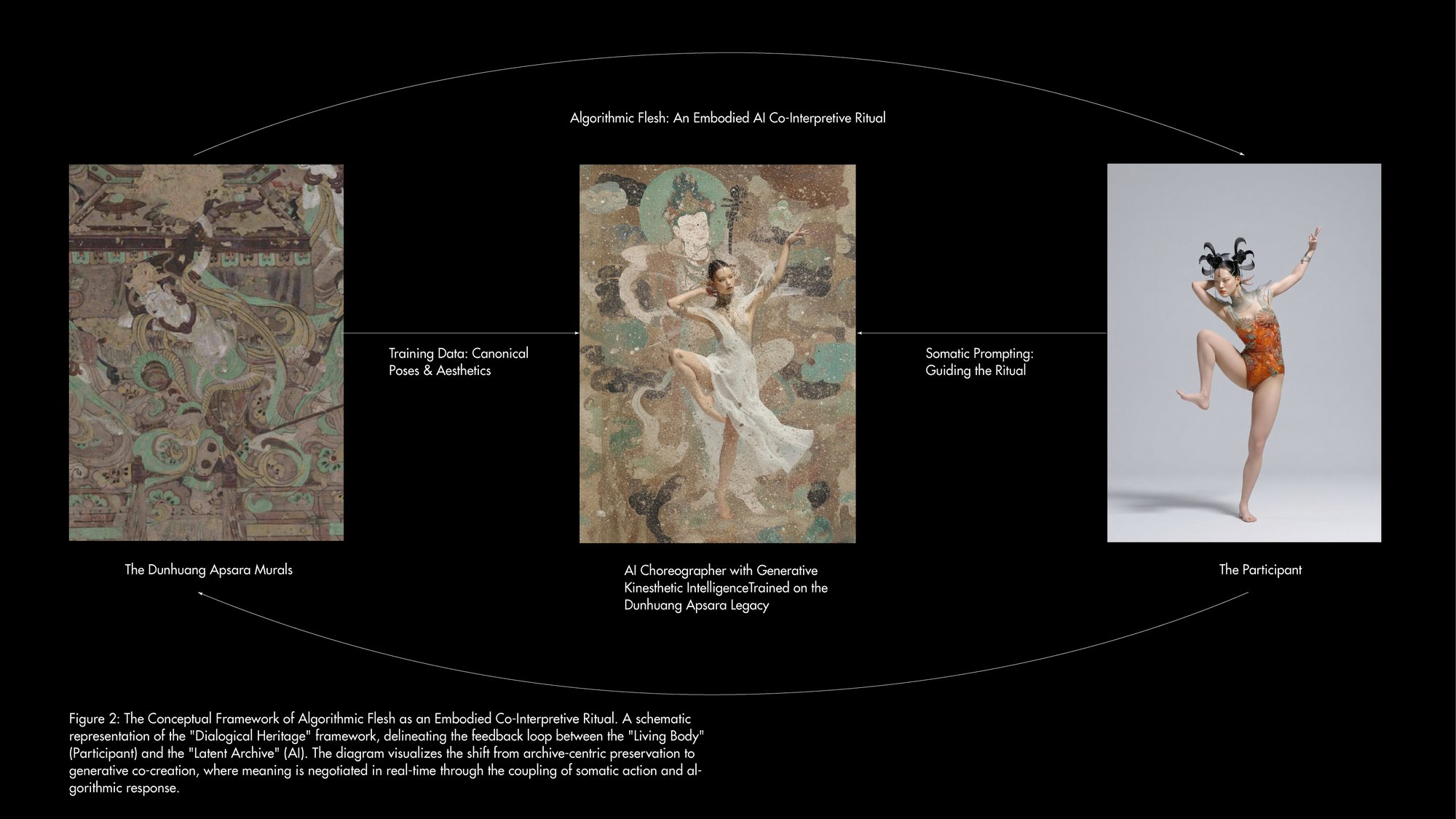
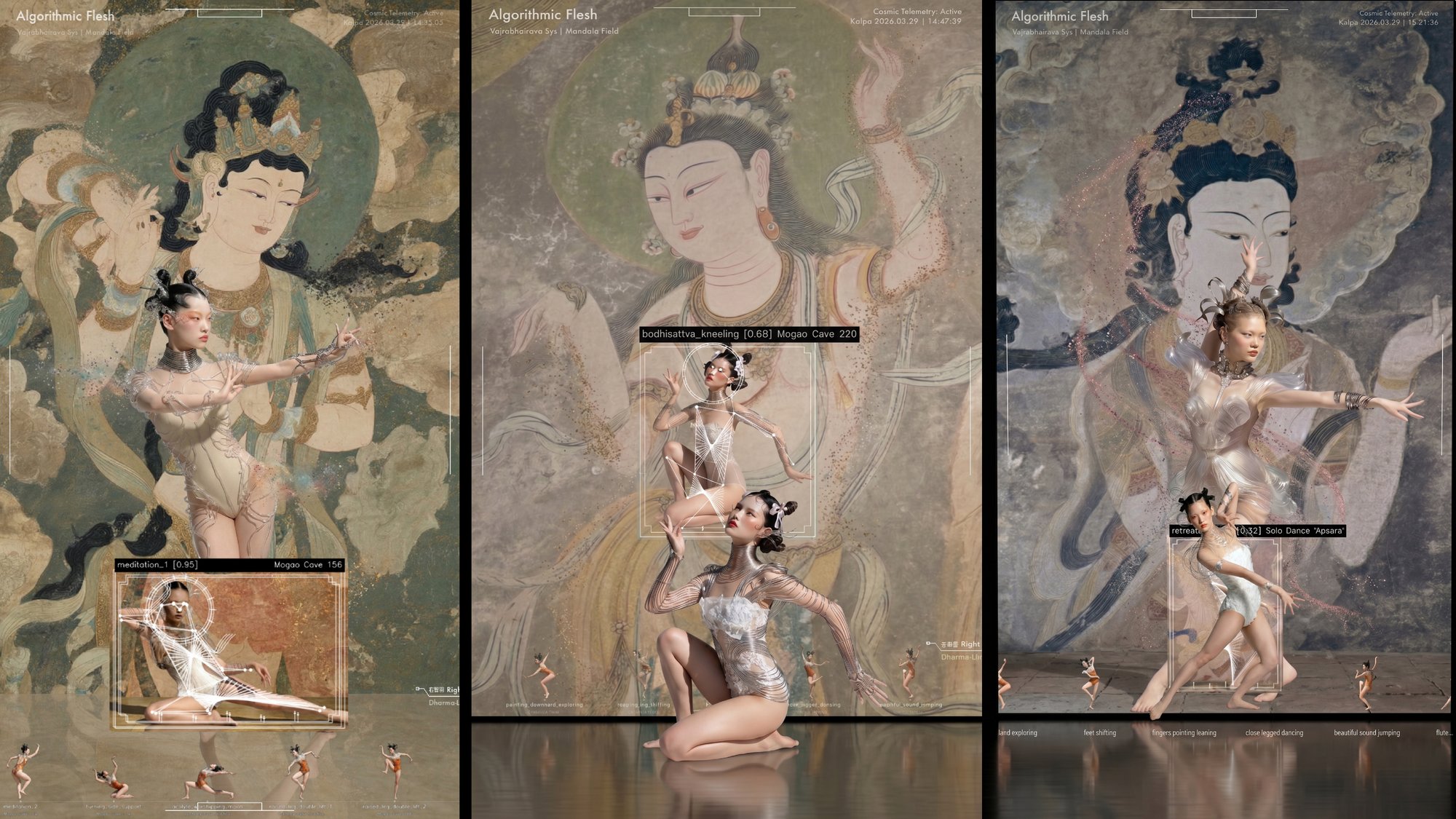
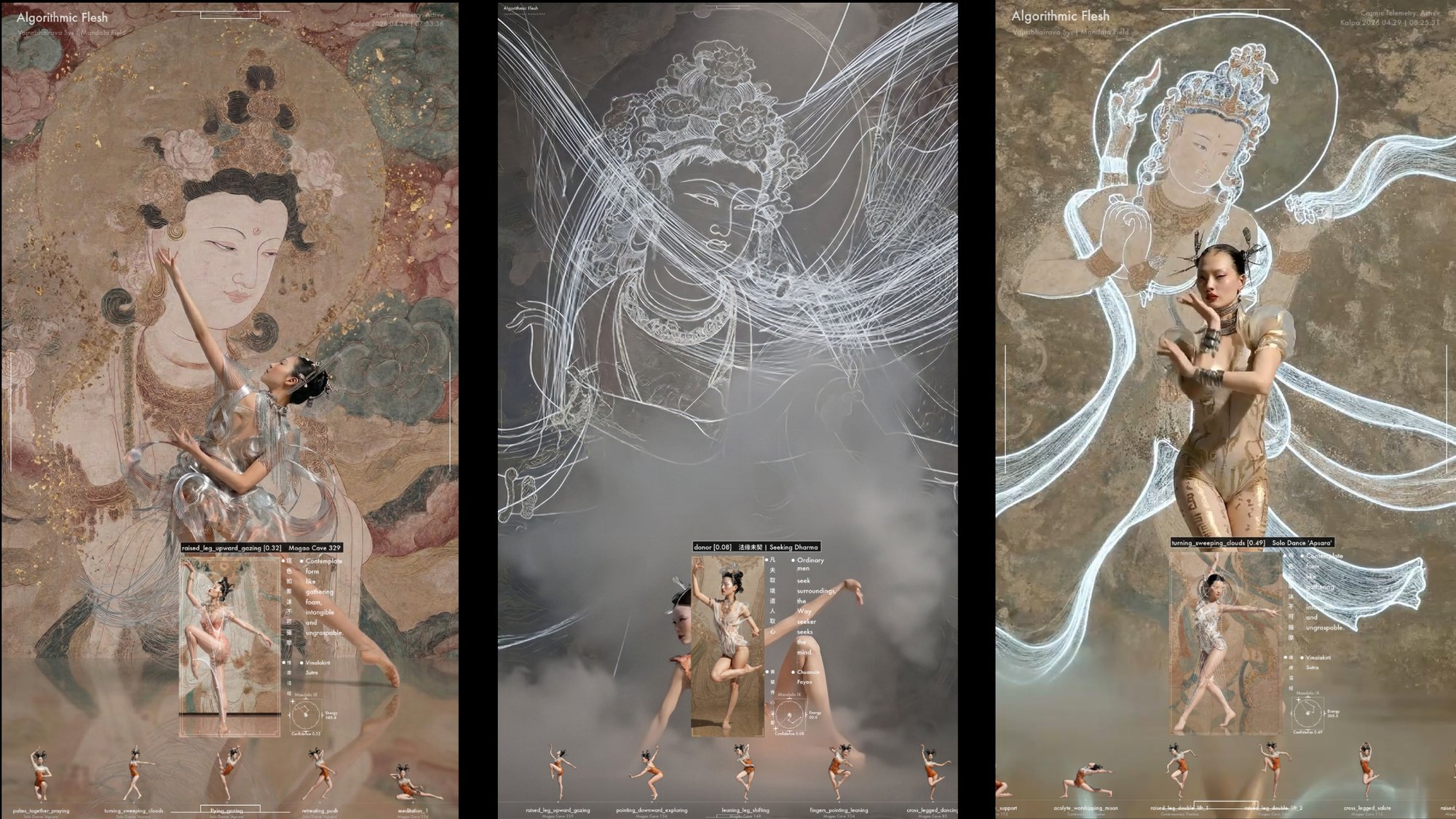
Algorithmic Flesh is an interactive multimedia installation that reimagines the UNESCO Dunhuang Apsara murals through a paradigm of somatic prompting. Moving beyond static digital preservation, this solo project translates empirical dance research into a real-time computer vision pipeline in which a visitor's posture — not a typed prompt — conditions the celestial dancer.
The Apsara of the Mogao Grottoes are not portraits. They are notations of movement, painted at architectural scale above bodies that could read them only by looking up — the posture of ritual. Wall and manuscript were one system: these are bianxiang, tableaux that carry scripture as image, painted for congregations who could not read the sutras and received them recited against the picture. Narrative, mudra, expression and posture did the work of doctrine.
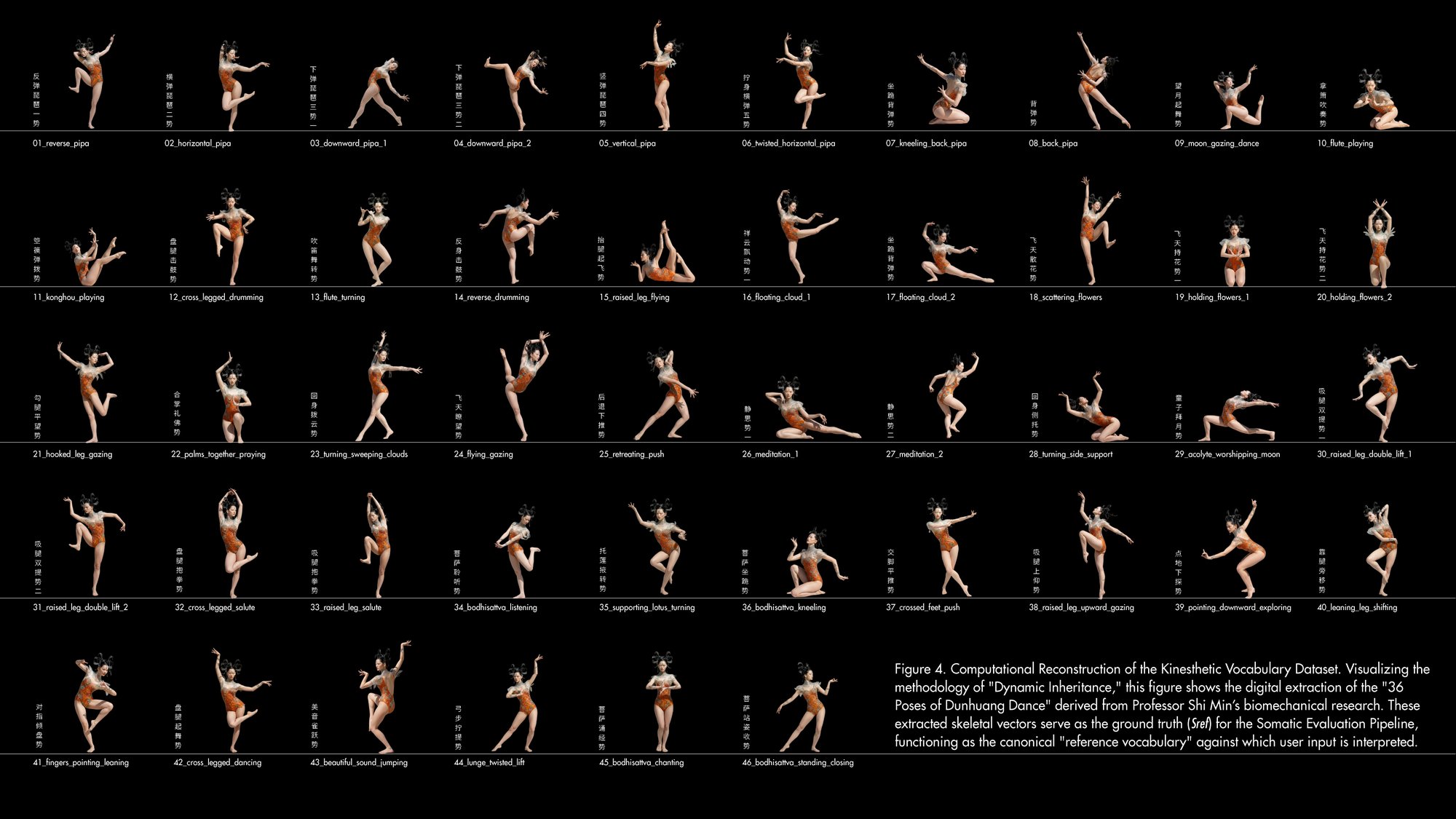
The dance itself was interrupted after the Tang dynasty and has no living transmission. Its source did not break: the 108 karana of the Indian Natya Shastra, from which this movement language travelled the Silk Road, survive in unbroken practice today. The archive holds arrested positions; the intervals between them were never recorded. Contemporary Dunhuang dance is a twentieth-century reconstruction — modern bodies extracted an aesthetic logic from mural images and, in extracting it, authored the tradition they set out to recover. The vocabulary this work reads was built that way: decades of somatic practice and biomechanical analysis of the murals, formalised as a pedagogical system long before any of it was made machine-readable.
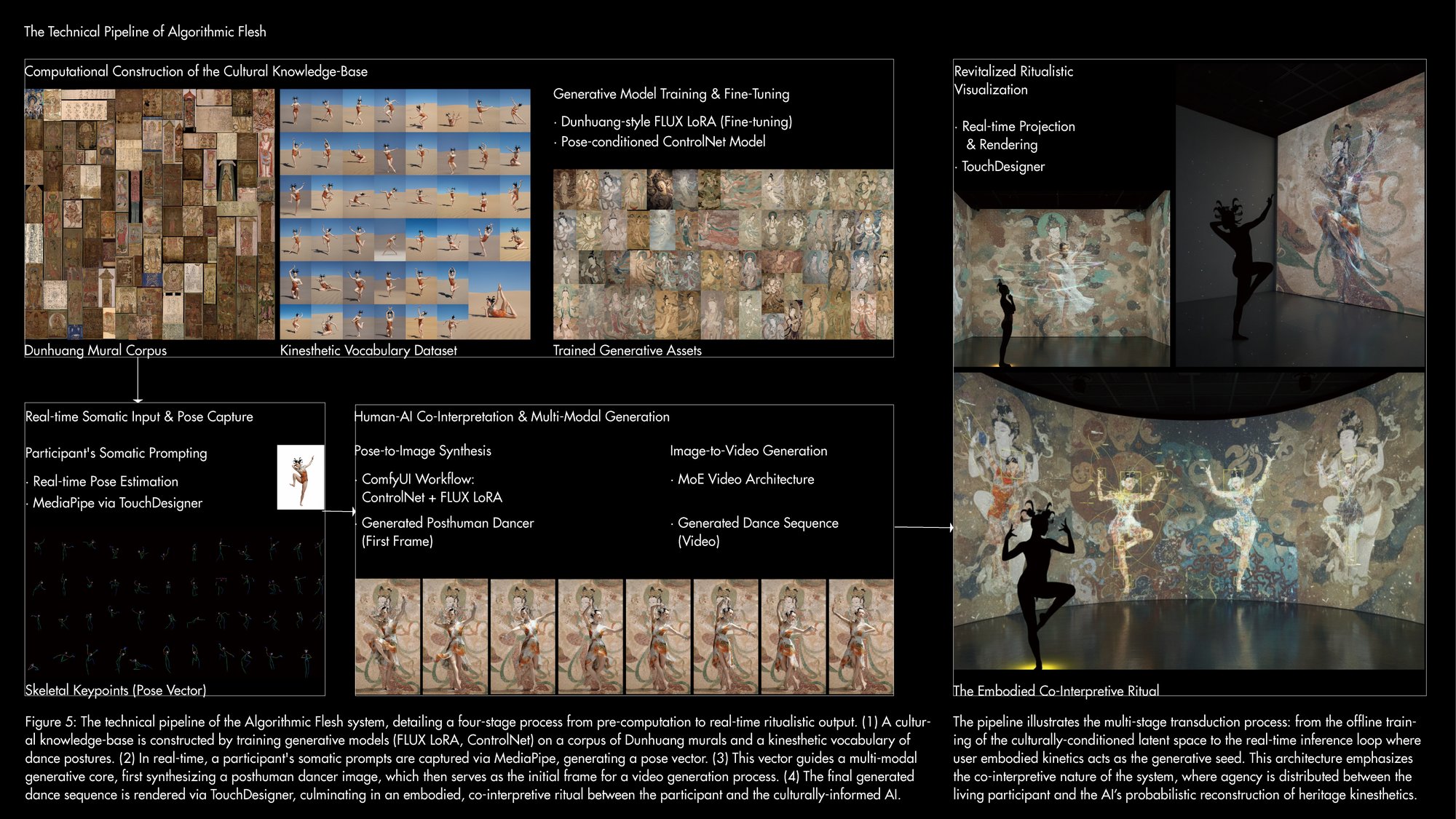
The work stands a visitor in that gap. One camera reads the body and keeps reading it; the figure that answers assembles itself from mural pigment, recognisably from the murals, recognisably not in them. This is somatic prompting — the body, rather than language, is what the generative system is given.
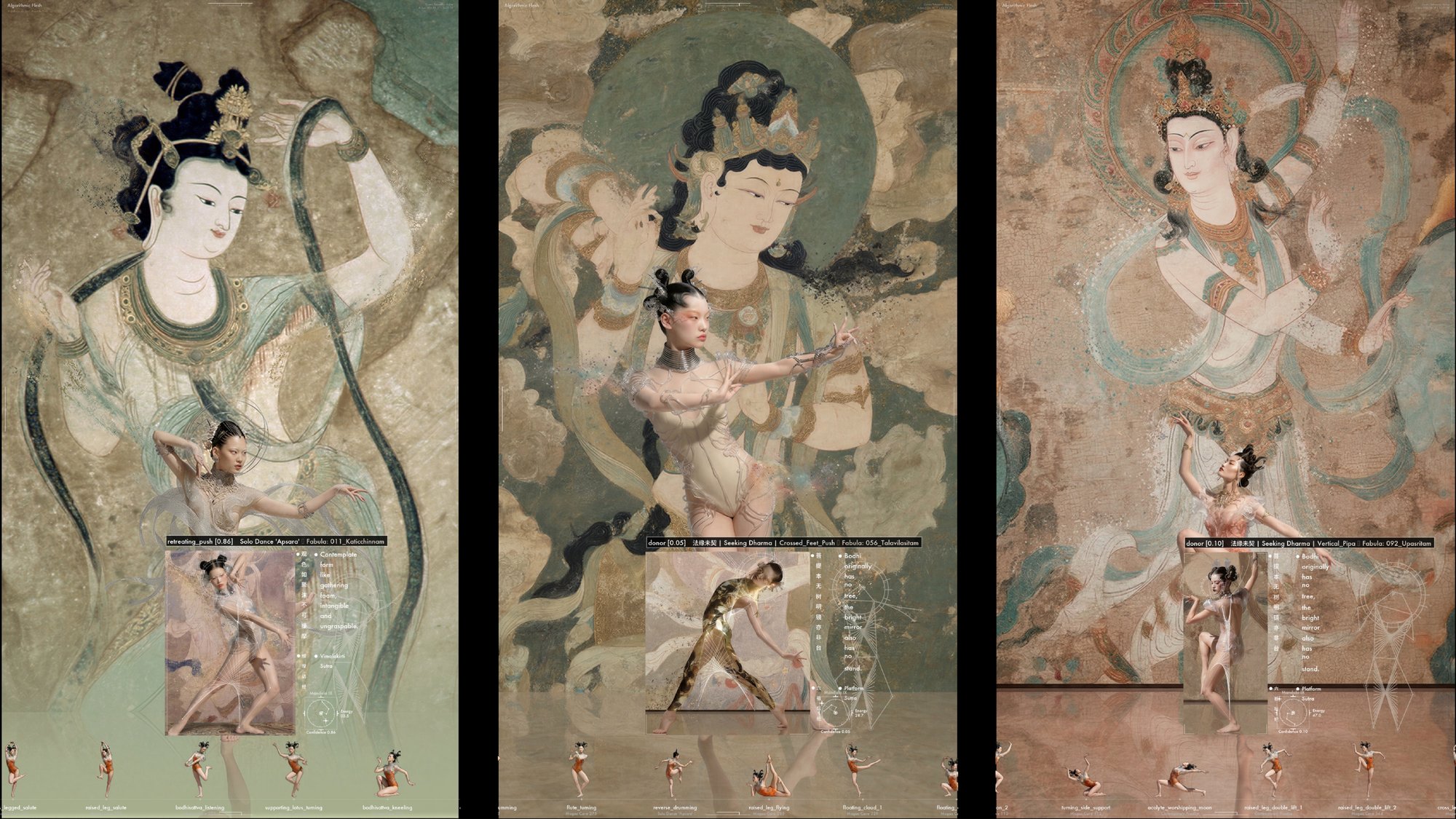
Crucially, what returns is not a mechanical restoration. Every posture is scored against both canons at once, so the interrupted tradition is read through the living one it descends from — speculative fabulation in a strict sense: inference along a line of transmission that still exists, not free invention. No threshold across the vocabulary isolates a single correct match, so a second figure, held above the visitor's sightline, cycles the candidates the archive cannot separate, three seconds each, settling on none. When a posture is recognised — the reverse pipa, the lute played behind the back — the archive also answers in language, drawing its text from the Dunhuang manuscripts, the pairing the caves were built on.
As a solo project, Algorithmic Flesh proposes a non-Western framework for cultural computing, spanning computer vision, dance practice and heritage research. It puts the murals back in front of a body, at the scale they were painted for. Cultural heritage here is not a static artifact but a living, co-interpretive performance — an archive that answers a body, and never twice the same way.
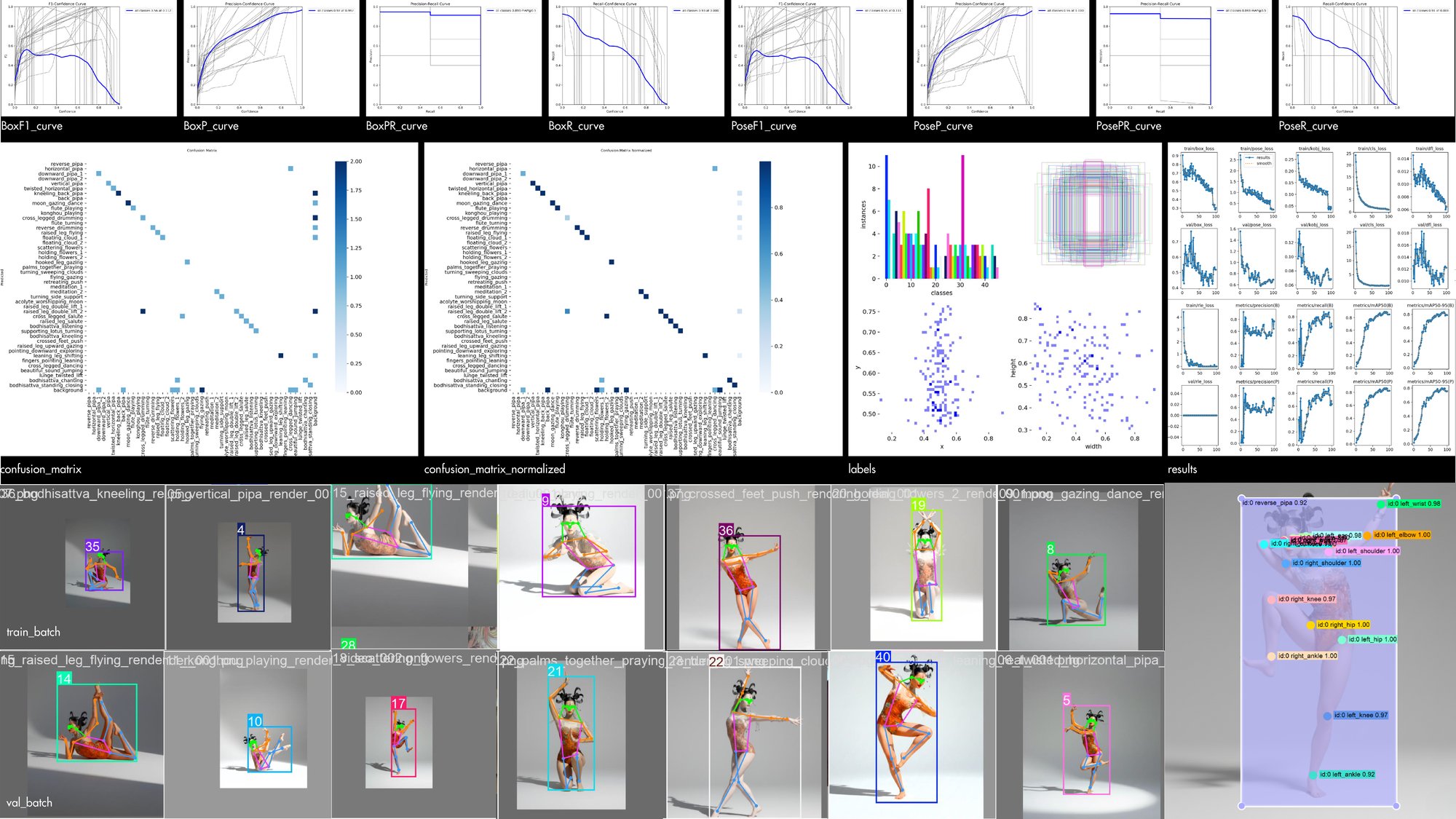
Input is a single webcam — no wearables, no calibration, no attendant. MediaPipe Holistic returns 33 landmarks per frame; the descriptor is hip-centred and scale-normalised. A YOLO 26 pose model fine-tuned on 46 Dunhuang postures — 17 keypoints, 190 hand-annotated images, pose mAP@50 0.853 — runs in parallel.
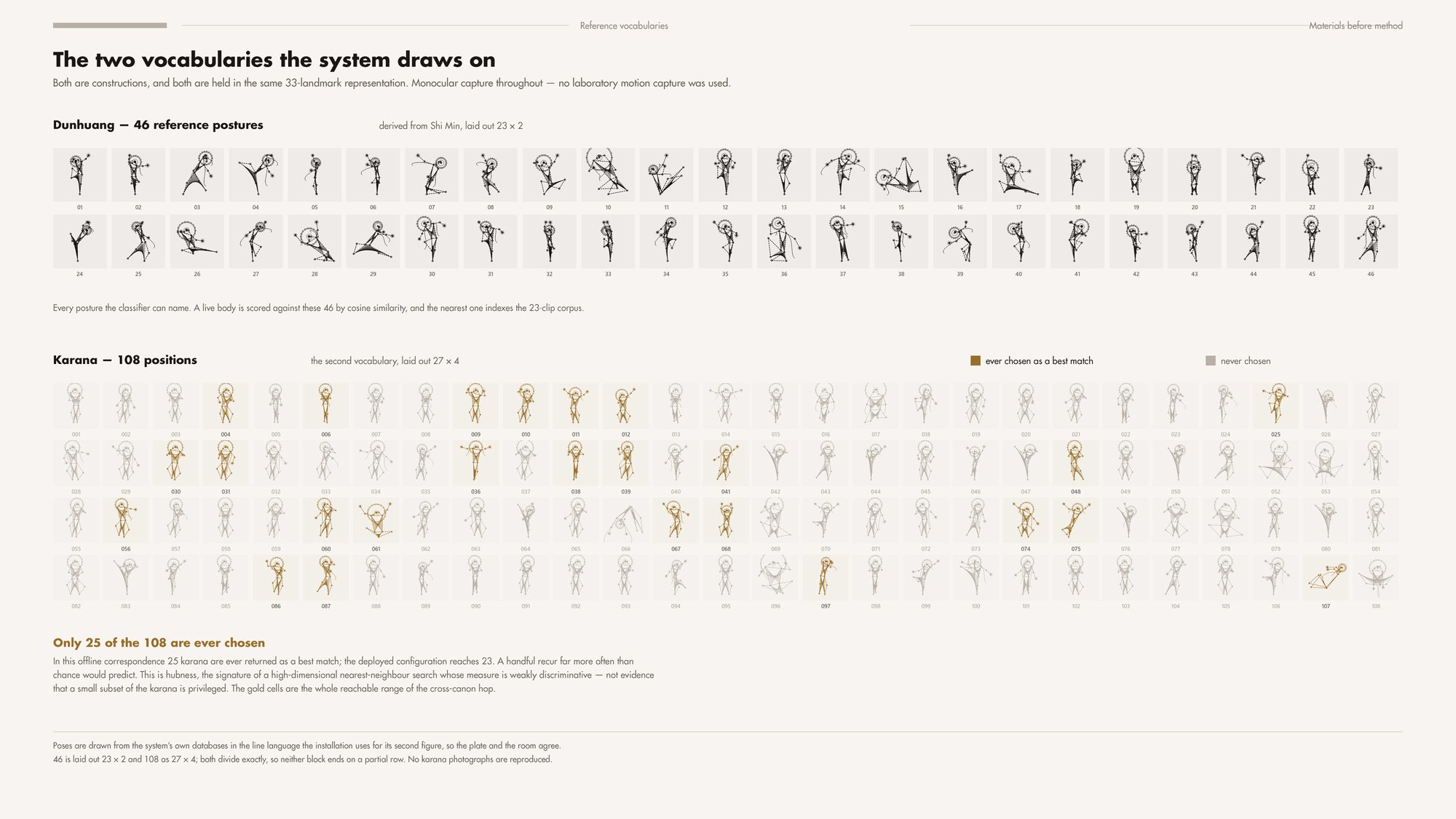
Matching is cosine nearest neighbour on the MediaPipe descriptor against two vocabularies: the 46 Dunhuang postures and the 108 karana of the Indian Natya Shastra, so one reading measures the interrupted canon against the living lineage it descends from. The matched posture keys a passage of the Dunhuang manuscripts. Every class within 0.03 of the best score joins a tied set; 34 of 46 postures produce more than one candidate, so ties are the ordinary case. Recognition costs 0.226 ms per frame.
Dancer material is generated in a customized ComfyUI workflow — FLUX.1-dev, ControlNet OpenPose, a Tang-iconography LoRA, image-to-video — and feeds TouchDesigner, which composites the installation. Output is the live selection, orientation and scaling of that material — the tied set cycling on a three-second dwell — plus a posture-driven sound layer, live-coded, over OSC. Everything runs locally on one workstation; the display is emissive because the sensing needs 150–300 lux.
Yalin Wang is a media artist and researcher, and a PhD candidate at the Central Academy of Fine Arts (CAFA), Beijing. She works in embodied museology, building interactive systems in which computer vision reads a visitor's movement and attention, and non-Western heritage — Dunhuang murals, Daoist star-pacing, displaced Buddhist sculpture — responds in real time rather than staying preserved and still. Her work has been shortlisted for the CVPR 2026 Art Gallery and selected for ACM Multimedia 2026 Interactive Art and ISEA 2026 (Dubai), and shown at CAFA Art Museum and Beijing's 798 Art District.