
1 / 11
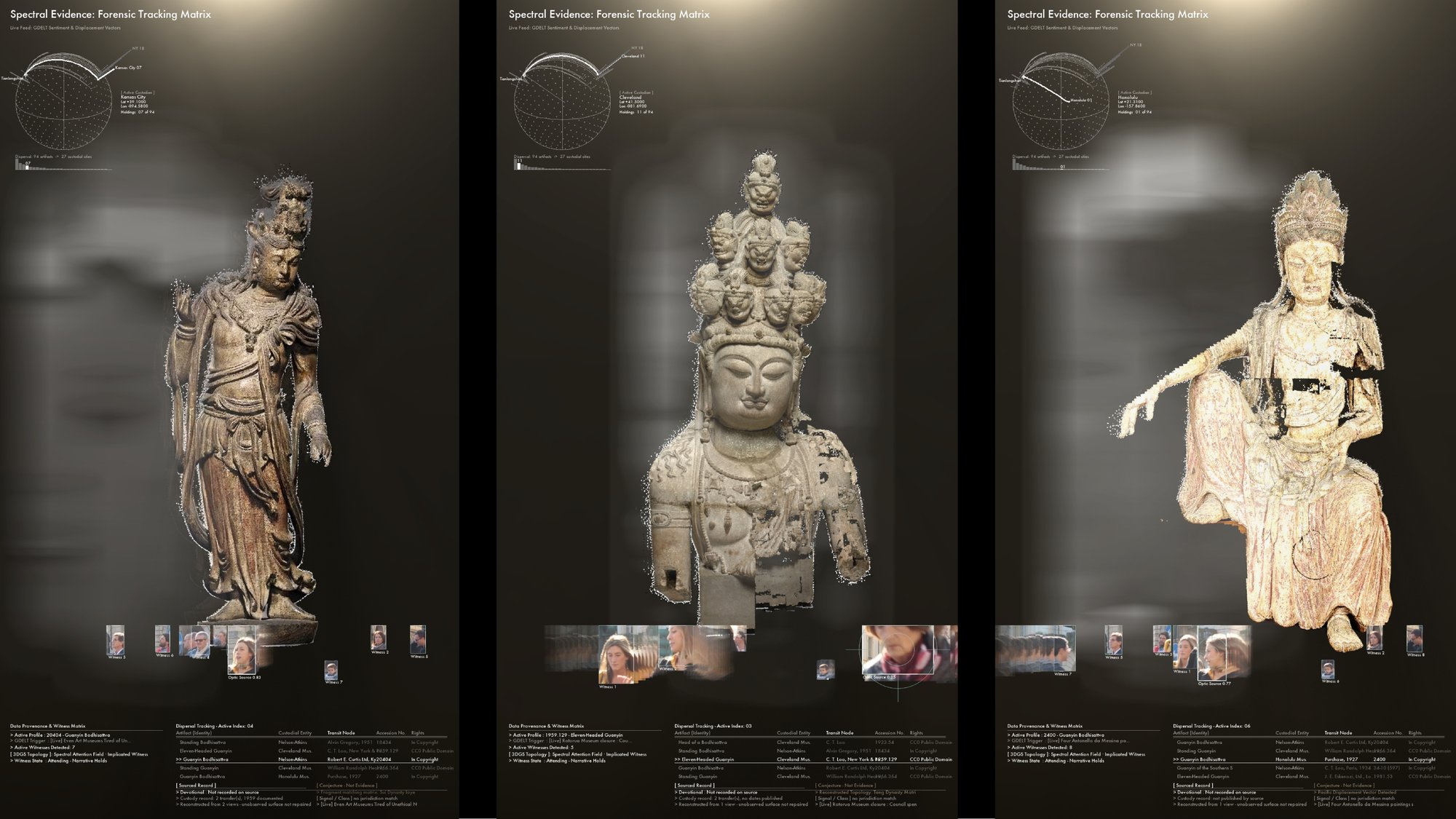
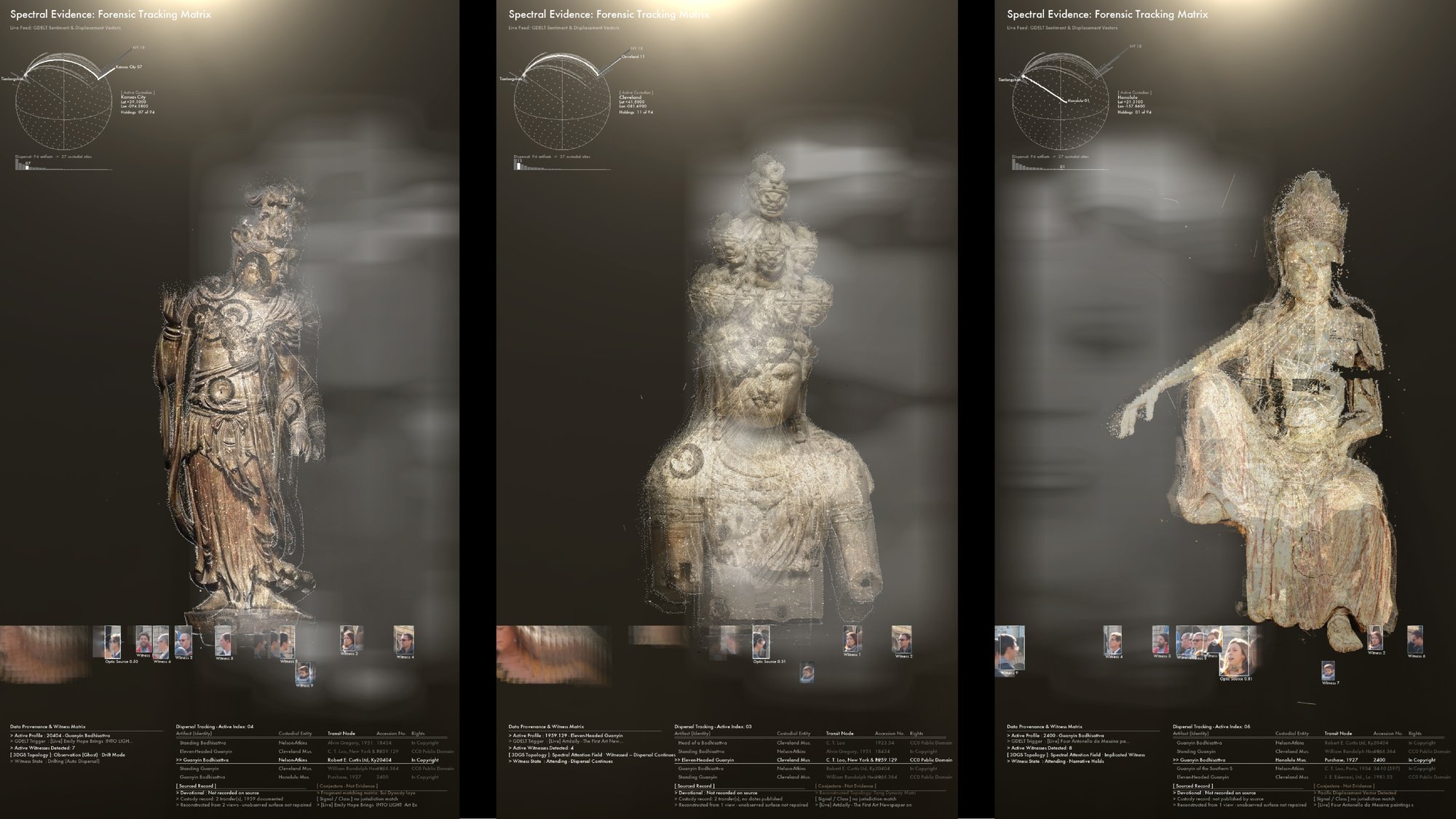
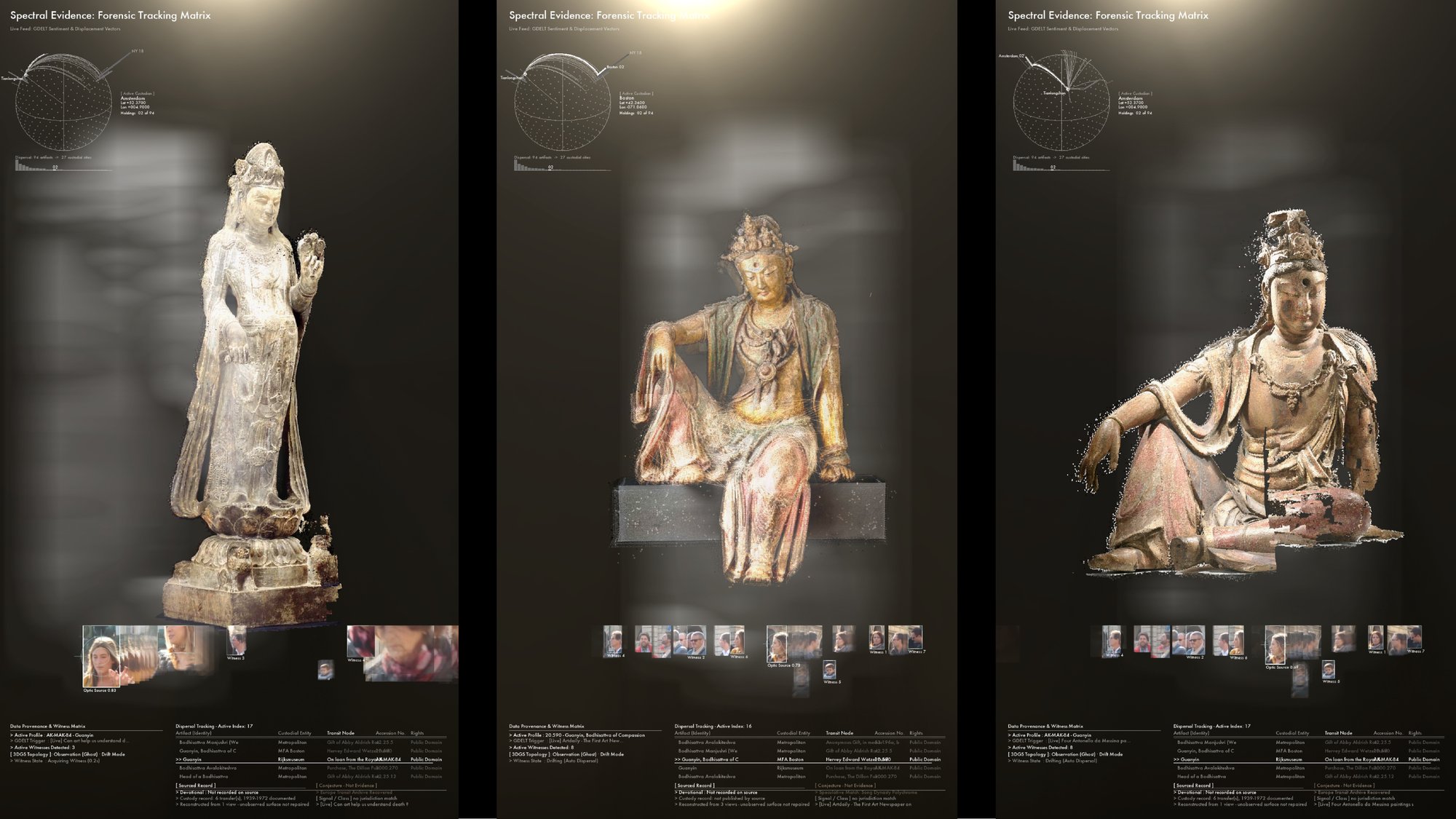
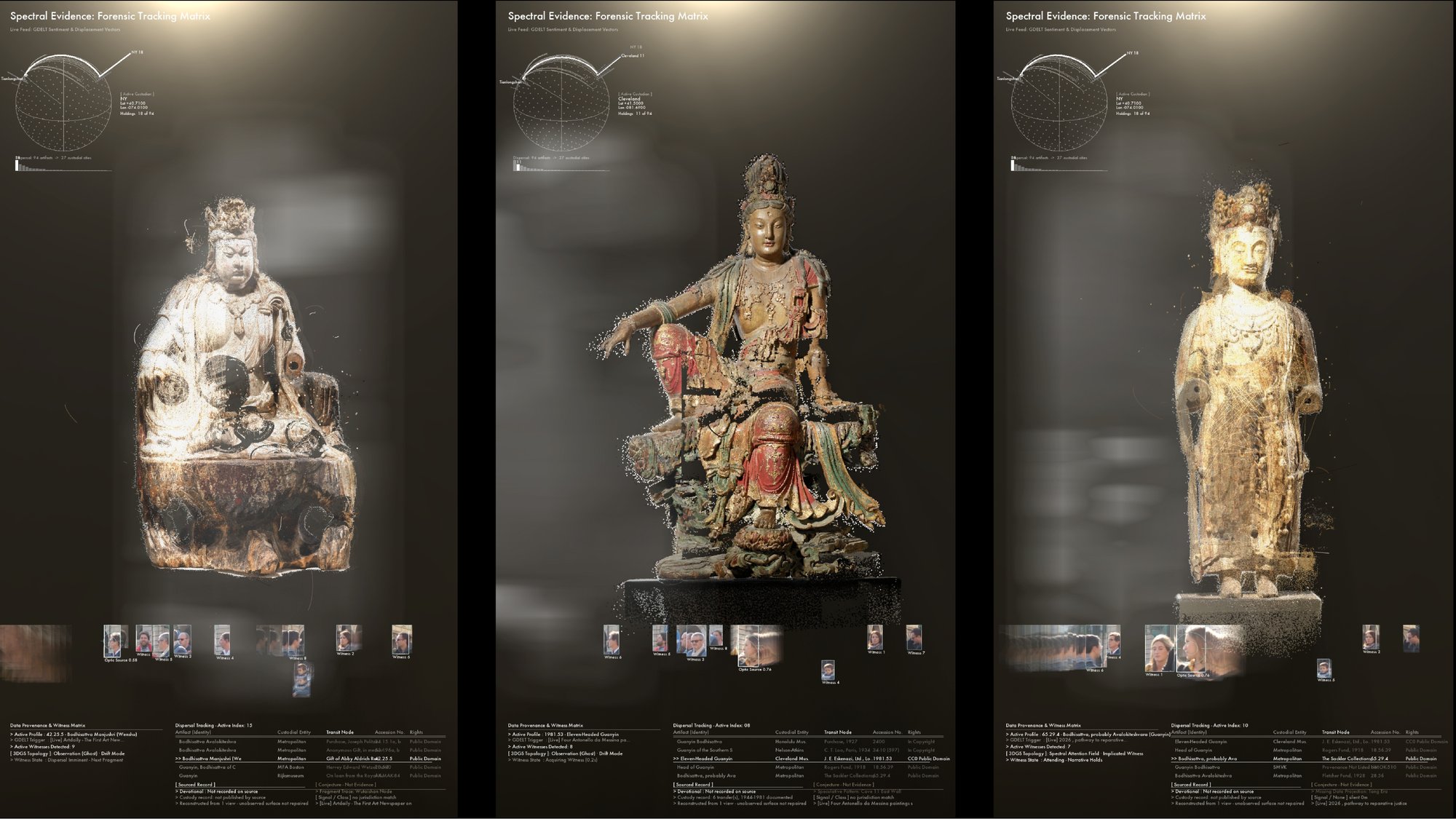
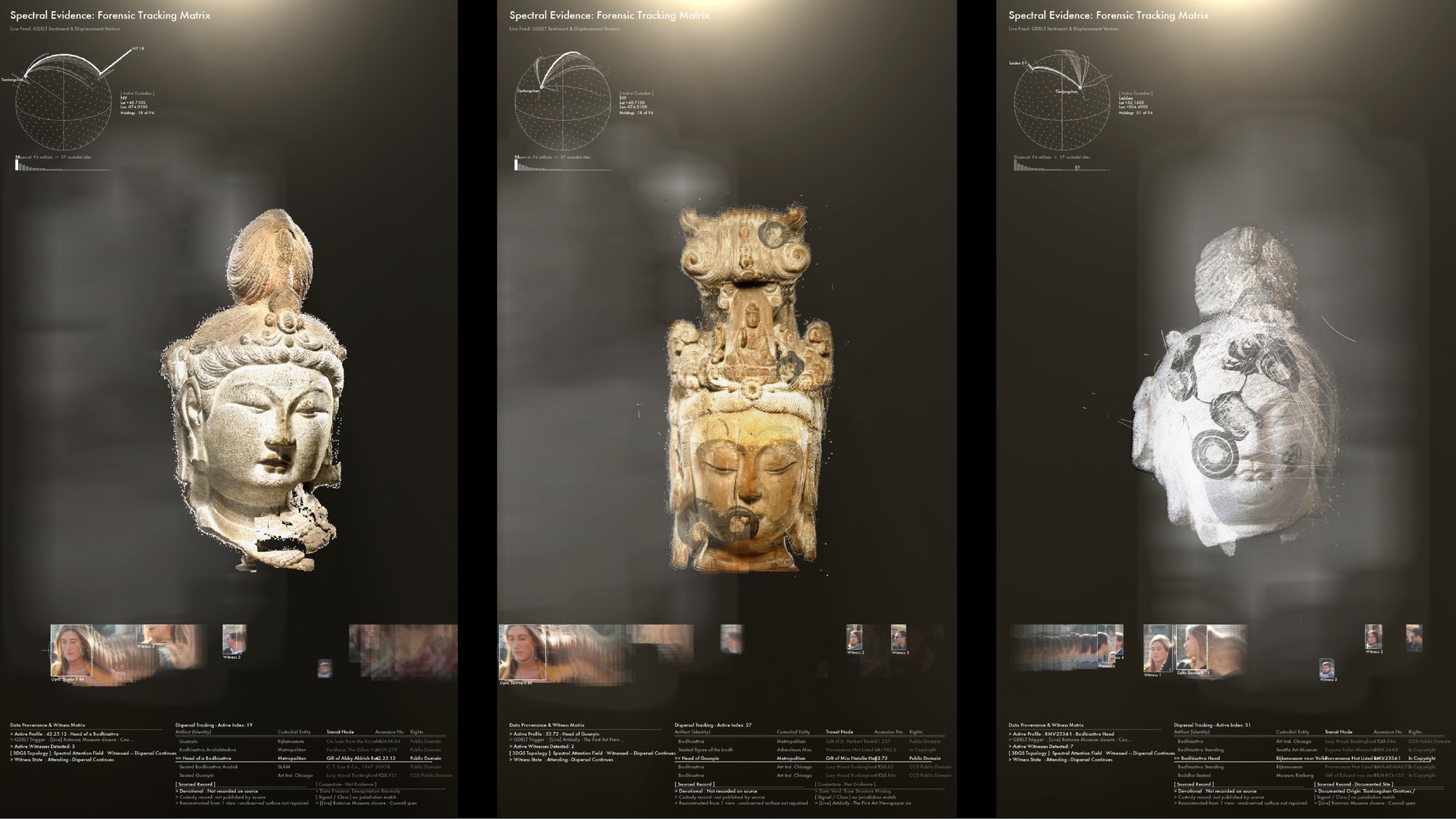
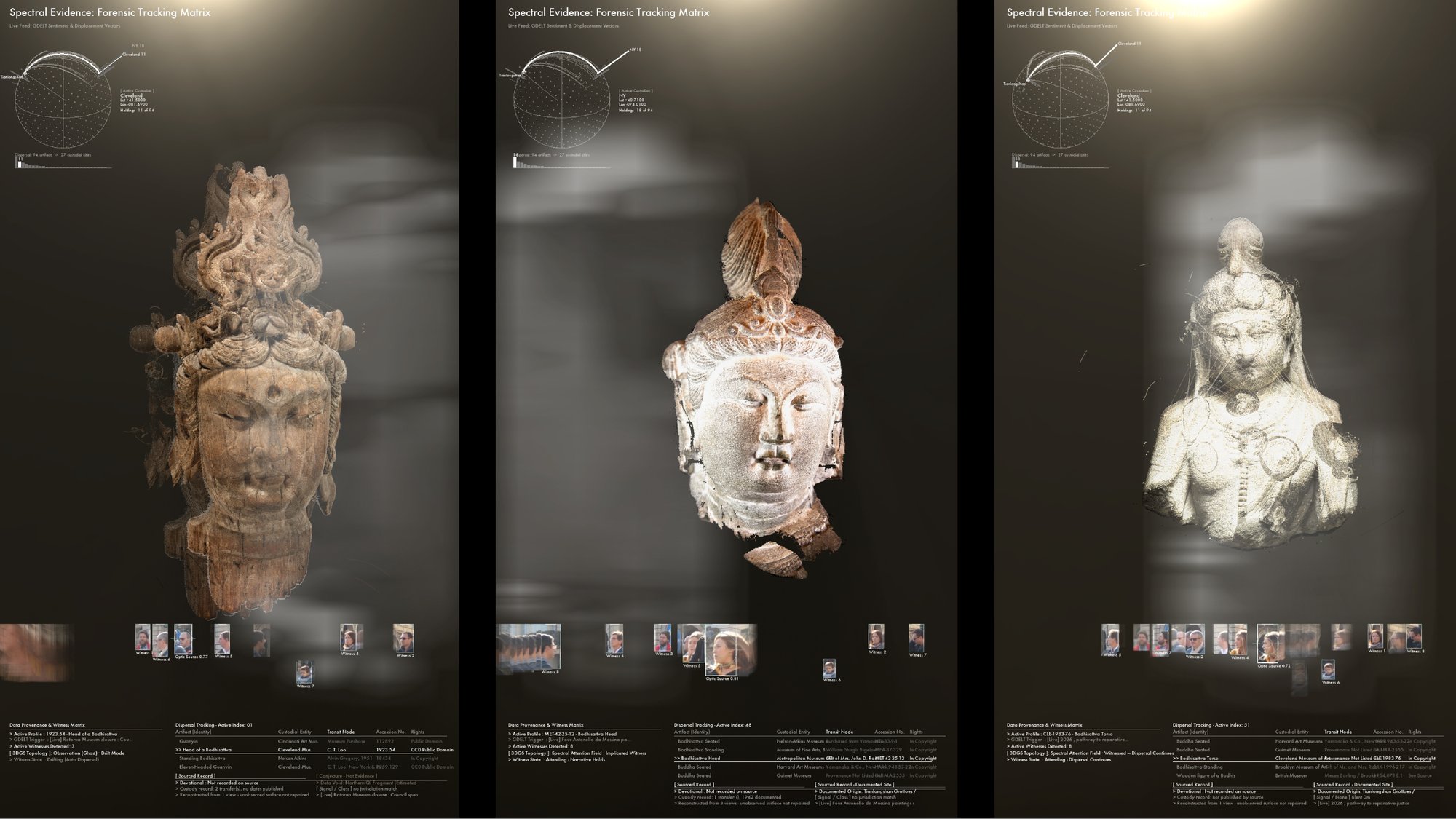
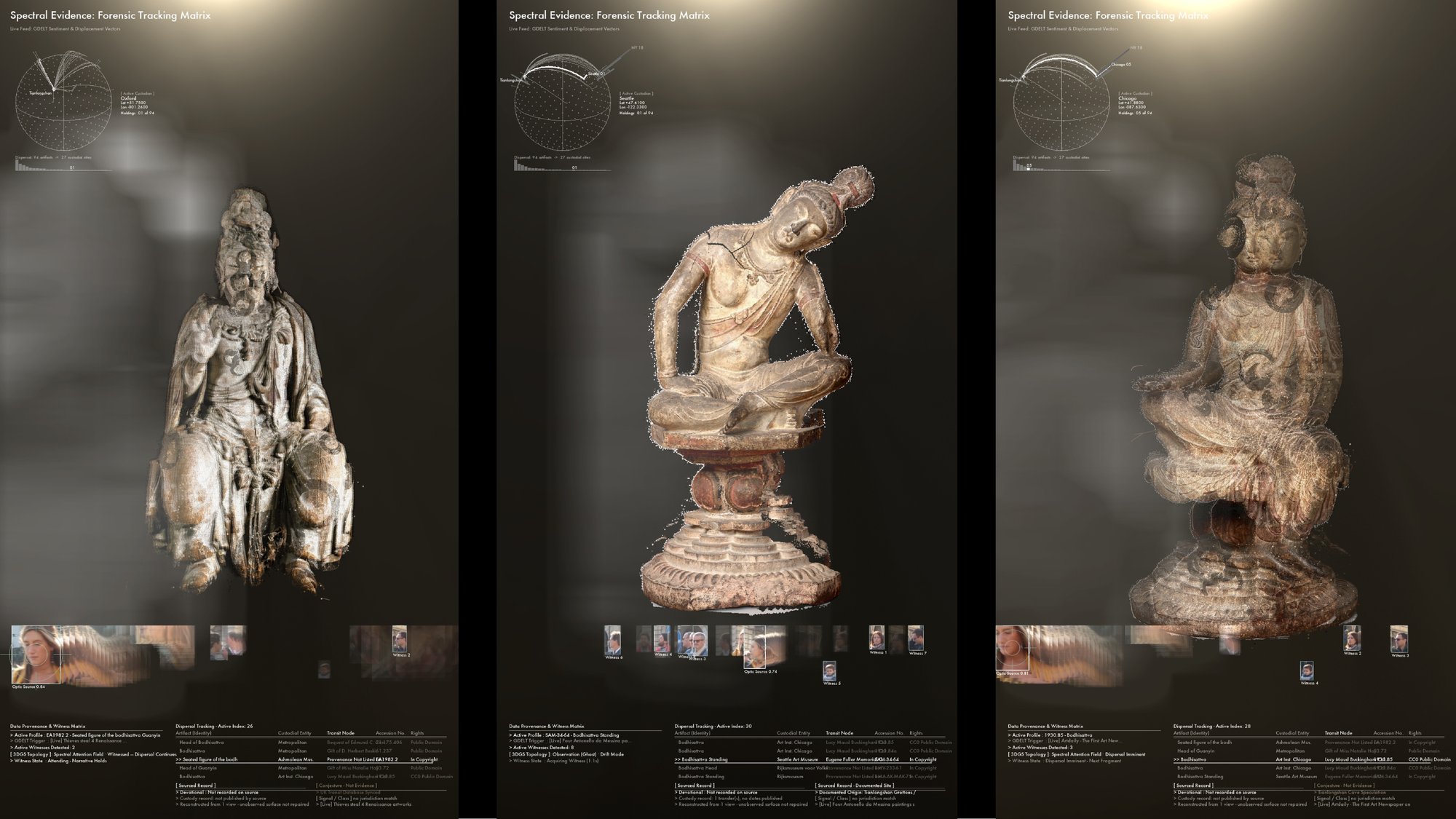
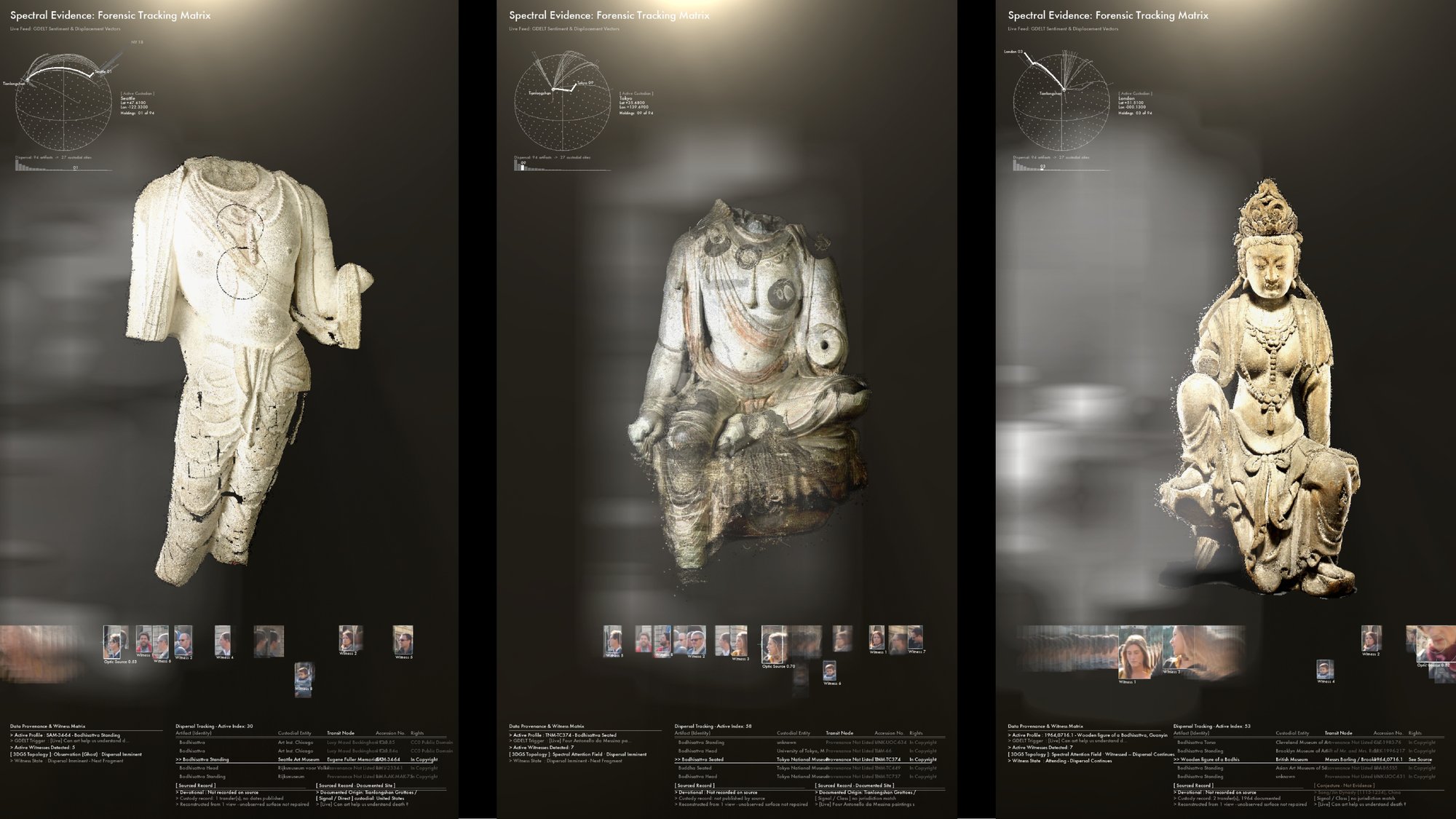
Spectral Evidence is a digital installation about cultural displacement. Using 3D Gaussian Splatting, it rebuilds severed Buddhist sculpture from the photographs its present custodians have chosen to publish, and then exhibits where that reconstruction fails, because the shape of the failure is the shape of what those custodians never photographed.
In the cave shrines of Shanxi and Hebei, in the first decades of the twentieth century, these figures were cut at the neck, and the damage they carry is not weathering but commerce: a head can be crated and shipped where an enthroned Bodhisattva cannot. The operation succeeded so completely that the survey behind this work has traced ninety-four such fragments to twenty-seven cities, with the dealers who moved them still named in the museums' own credit lines. That count is provisional, and it has only ever risen.
They now stand in Zurich, Boston, New York and Tokyo, so that someone from the culture that made them needs a passport, a visa and an airfare to see one, while for a resident of the holding city it is a Sunday afternoon. Looking has become a privilege administered by geography, and the arrangement that produced it is not a closed chapter of colonial history but a condition maintained daily, in opening hours and in the single photograph released to the public.
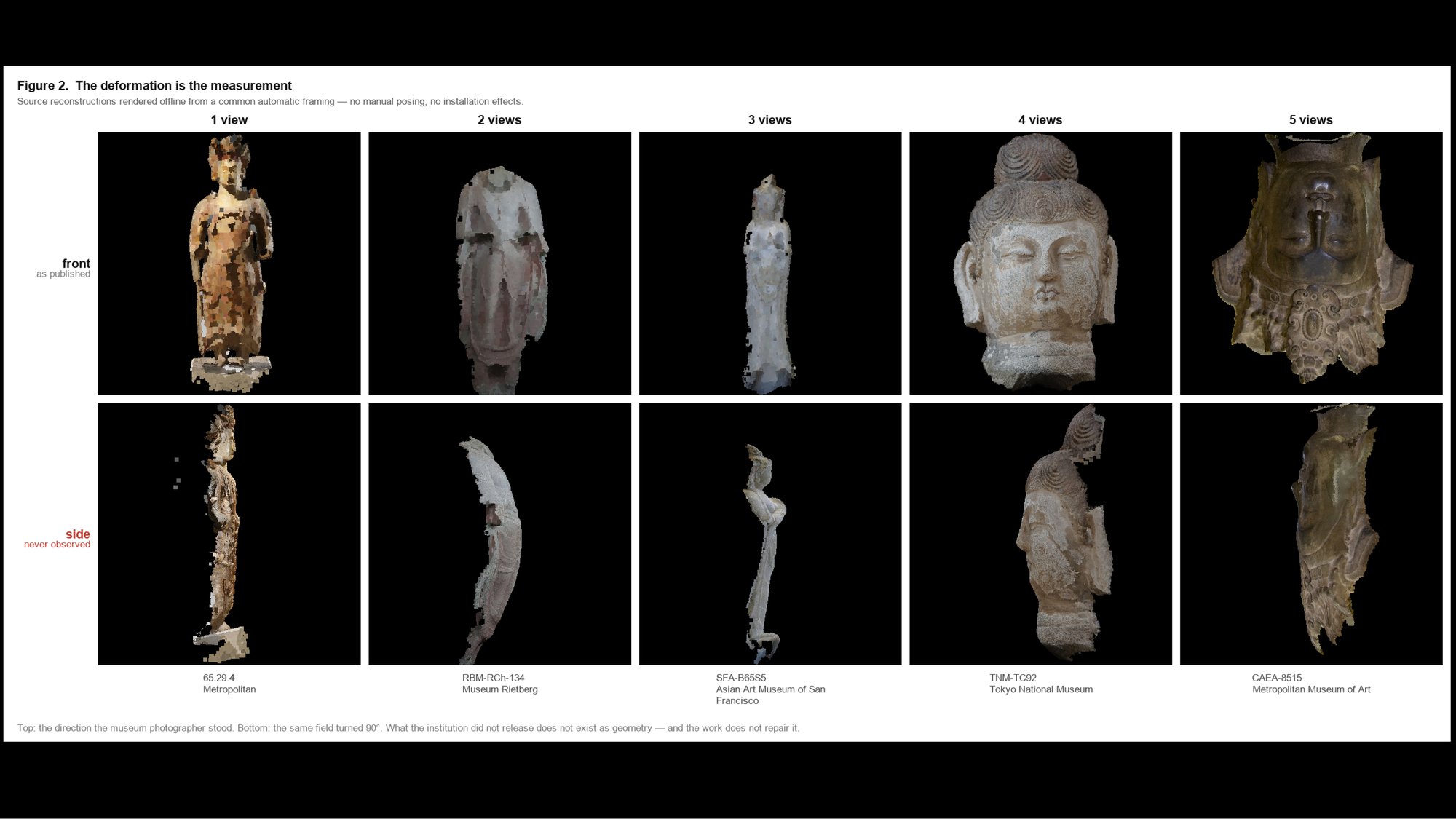
These images were gathered the way the sculptures themselves were gathered, which is to say without asking. What limits the reconstruction, though, is neither permission nor copyright but coverage: an institution publishes one photograph of an object, sometimes a profile as well, almost never the dense capture a reconstruction requires, so that across this corpus the median is a single view.
Reconstructed under that constraint, a figure comes out exact along the one sightline a museum photographer once occupied and invented everywhere beyond it — a face with no skull behind it, a torso that dissolves as soon as you move ninety degrees around it. None of this is corrected, because the deformation is the finding rather than a defect in it.
What holds such a body together is attention, the scarcest thing in the room and the only force the work actually runs on. A figure gathers while people keep looking and comes apart as soon as that looking moves on, and the interface names the visitor for the part they are playing, framing each face the camera finds along the lower edge and labelling it Witness. To witness is to be implicated, and it is also not enough, since the figure disperses in the end whether anyone stays or not — attention can hold a thing together for a while and still not be able to keep it.
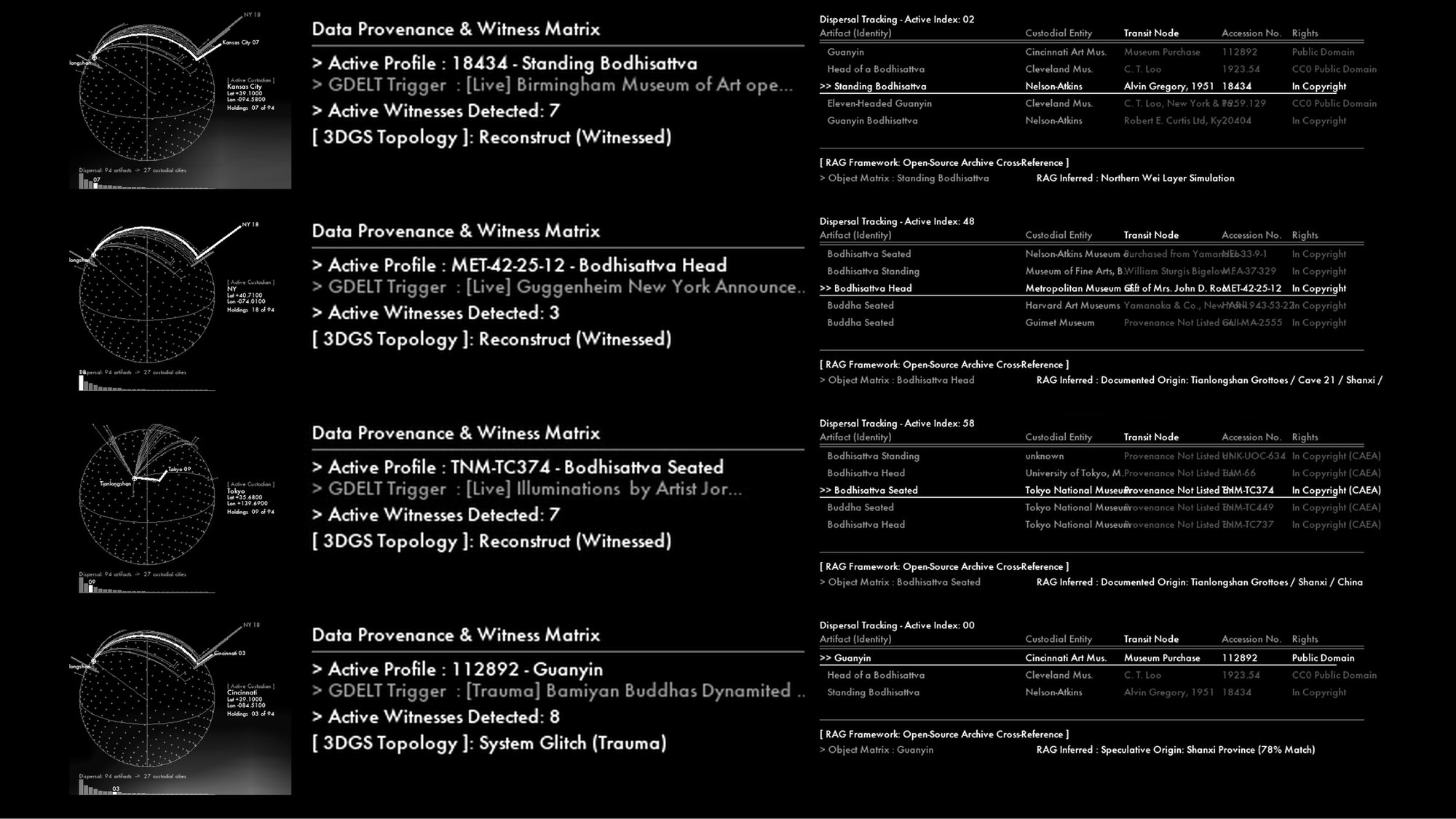
Where the record ends, the work ends with it: objects whose custodian is listed as a private collection, or simply as unknown, are not reconstructed at all, since there is no one to ask, and the refusal is displayed as a state of the system. What remains is a speculative restitution and nothing firmer — a body reassembled out of public fragments and held upright by the attention of people who will most likely never stand in front of the original.
Inputs are what museums publish for each traced fragment: photographs, median one view per object, and catalogue records giving custodian, accession, rights and provenance.
Reconstruction is 3D Gaussian Splatting run in a deliberately degenerate regime — one to five views per object, no supplementary capture — so geometry is constrained only along the published sightlines. Those artifacts are kept rather than inpainted, and the corpus is organised to make them comparable: objects of similar type and scale under sharply unequal coverage.
At runtime the splat drives a GPU particle simulation in which an attraction term binds points to the reconstructed surface against a dispersal term pulling them off it. Two live signals set the balance: an on-device YOLO26 person detector reduced to head count, proximity and orientation, and a GDELT query filtered to each object's custodial or origin country. Detected faces are shown, numbered per frame beside the detection confidence; no frame is stored or transmitted, and a camera-off mode is disclosed.
Output is a single rendered channel: the field plus a forensic overlay keeping source record, archive cross-reference and conjecture in separate registers, with no confidence figure attached to any claim about an object.

Yalin Wang is a media artist and researcher, and a PhD candidate at the Central Academy of Fine Arts (CAFA), Beijing. She works in embodied museology, building interactive systems in which computer vision reads a visitor's movement and attention, and non-Western heritage — Dunhuang murals, Daoist star-pacing, displaced Buddhist sculpture — responds in real time rather than staying preserved and still. Her work has been shortlisted for the CVPR 2026 Art Gallery and selected for ACM Multimedia 2026 Interactive Art and ISEA 2026 (Dubai), and shown at CAFA Art Museum and Beijing's 798 Art District.