
HEXfast at Tiffany's_Frederik De Wilde_2026 1 / 11
Logline Hybrid intelligence in which machine-learning systems and an evolutionary agent ecology co-produce the digital painting that turns computation itself into both medium and subject.
Synopsis HEXfast at Tiffany’s is ultimately less about Tiffany Blue than about the infrastructures that increasingly govern contemporary life. As AI systems learn to classify, monitor, and regulate everything from images to identities, the ownership of colour becomes a lens through which to examine the politics of computation itself. The work proposes that the next frontier of artistic practice may no longer lie in the creation of images, but in interrogating the systems that determine how images—and the world they describe—are allowed to exist. Using proprietary HEX codes—including the iconic Tiffany Blue associated with Pantone 1837—as computational material, the work transforms the chromatic field into an evolving environment where machine-learning systems continuously observe, identify, and respond to colour in real time. HEXfast at Tiffany’s asks not only who owns colour, but who controls the systems through which colour is recognised, classified, and made visible. The work turns computational governance into an artistic process, positioning autonomous machines simultaneously as instruments of enclosure and potential agents of its disruption.
/
HEXfast at Tiffany’s: When Colour Became Property
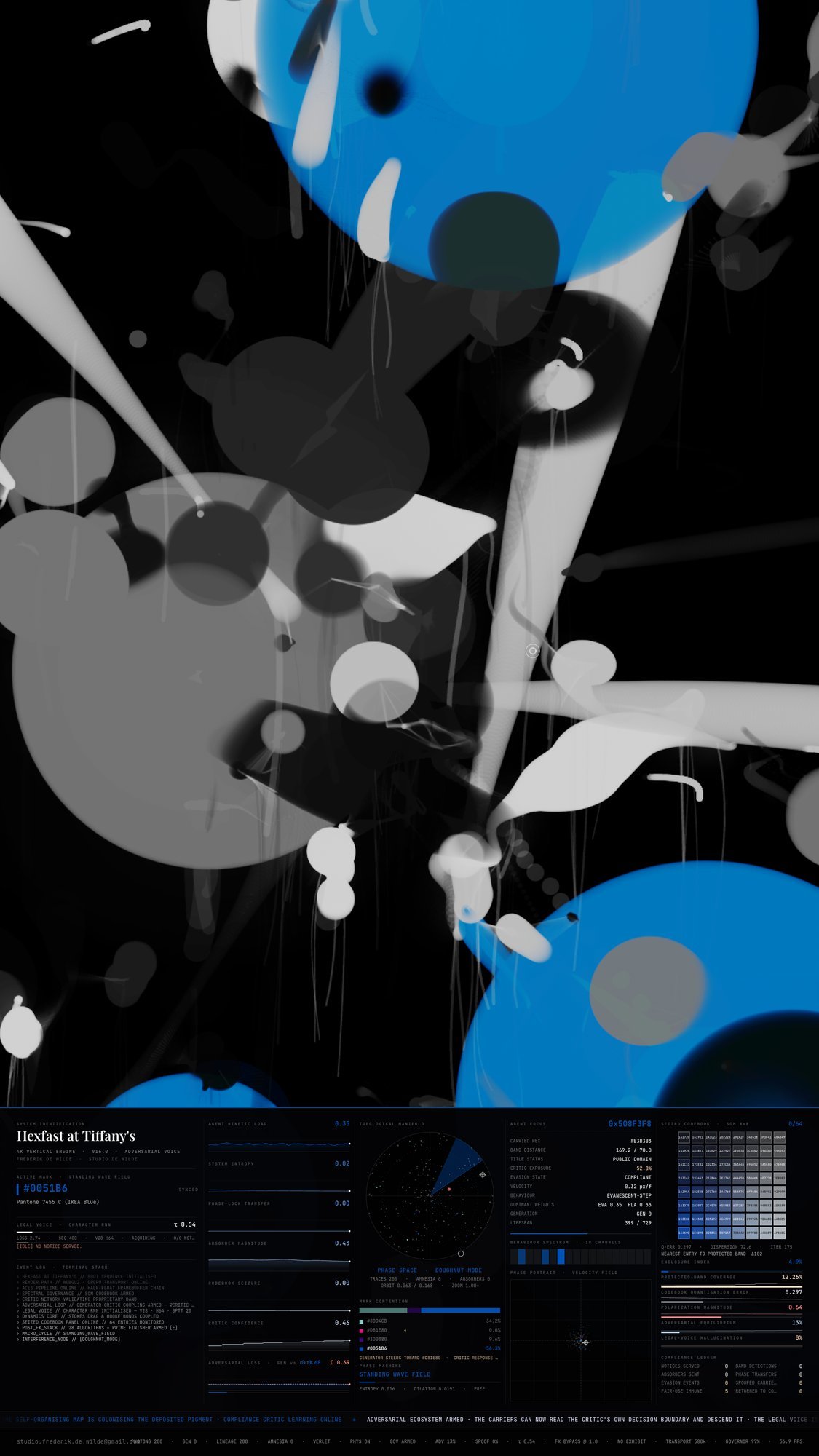
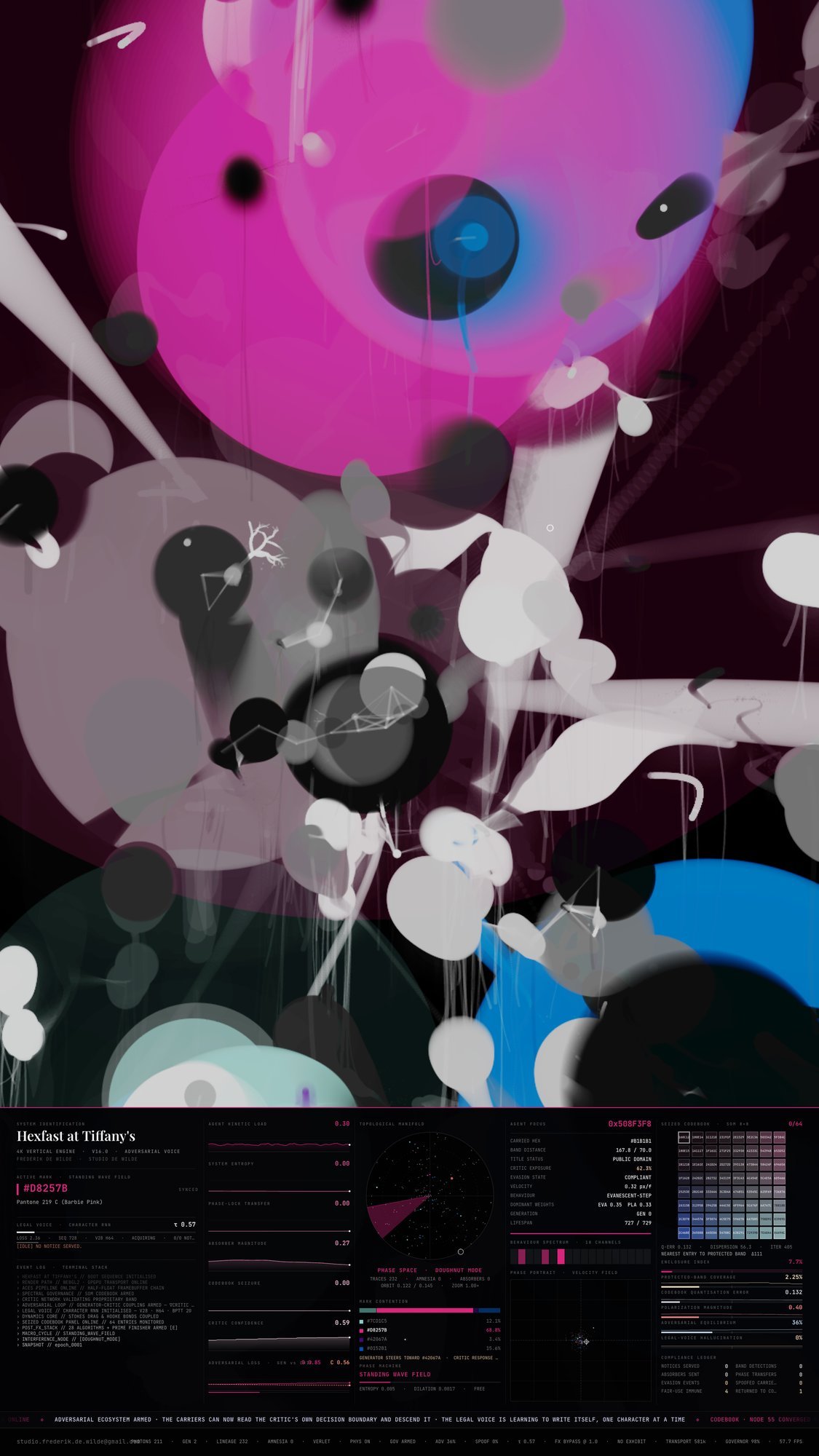
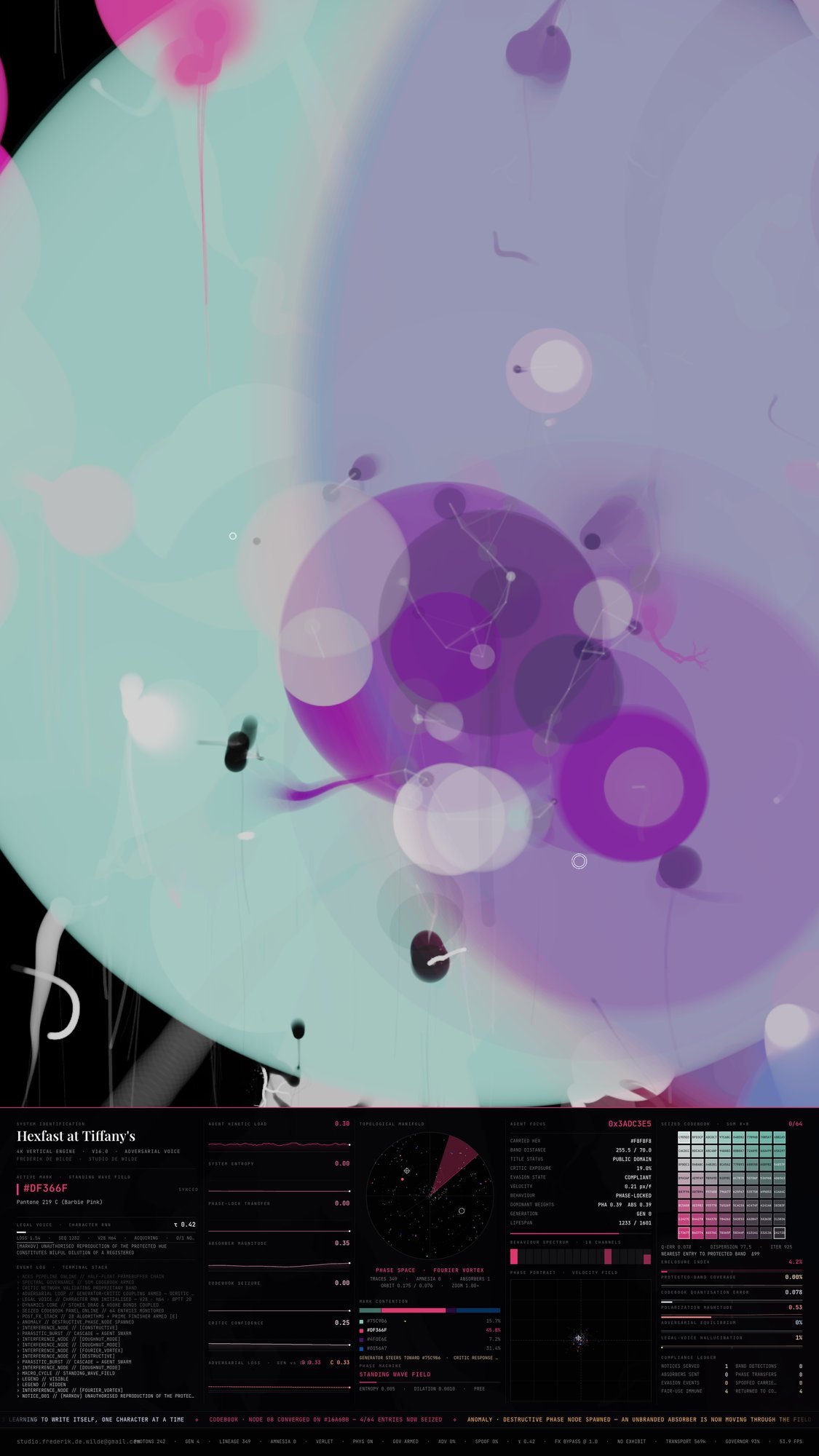
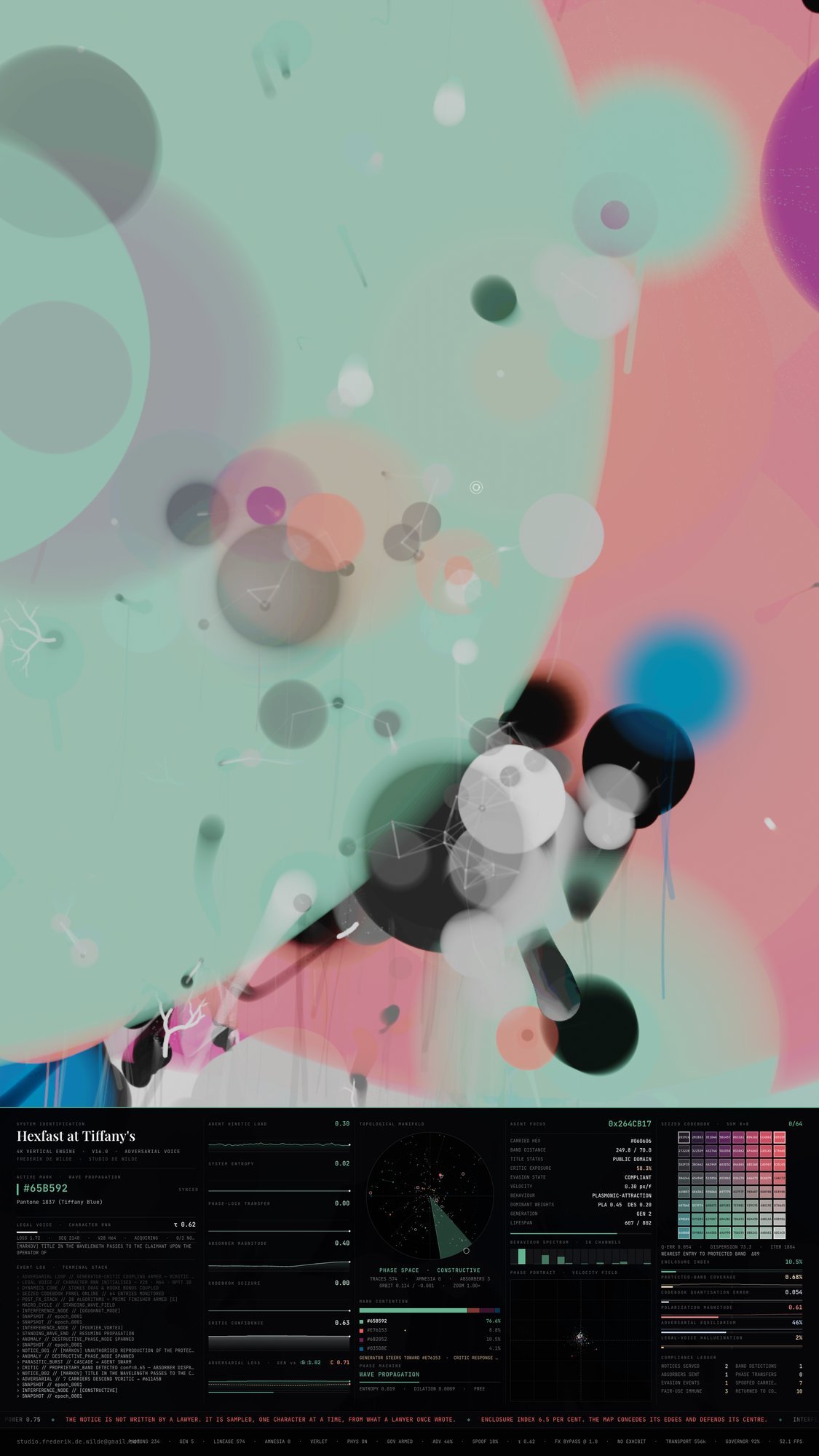
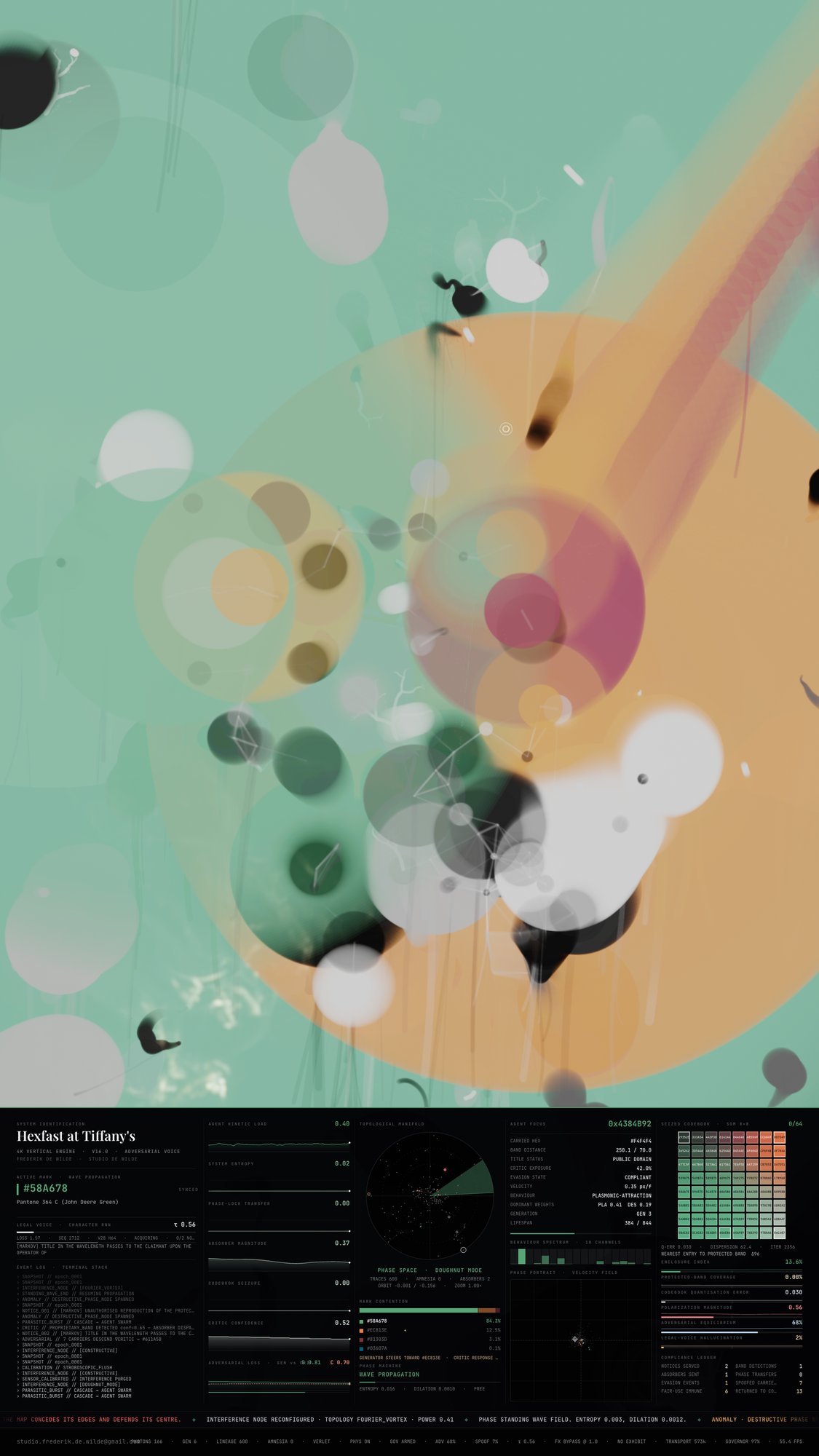
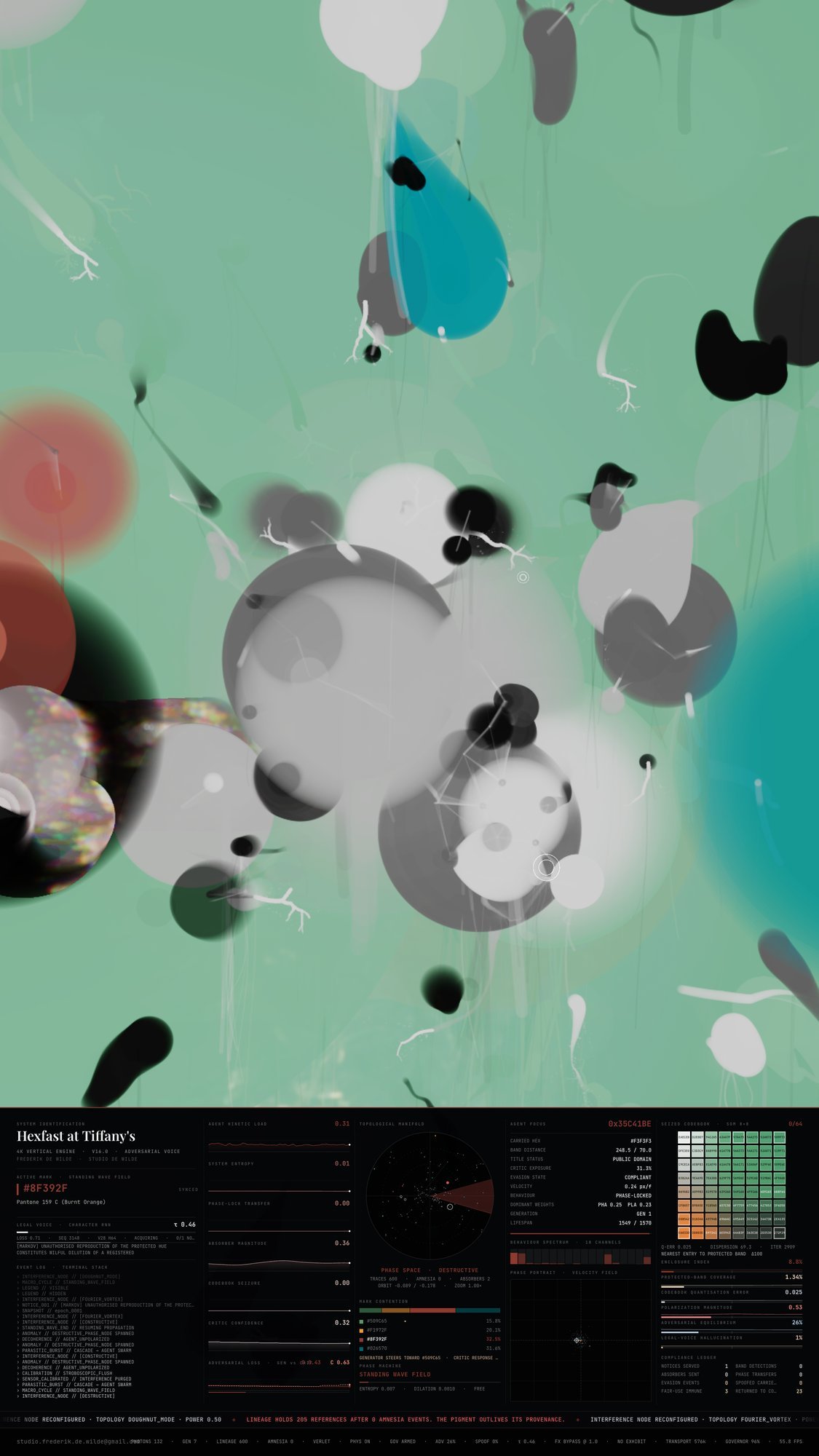
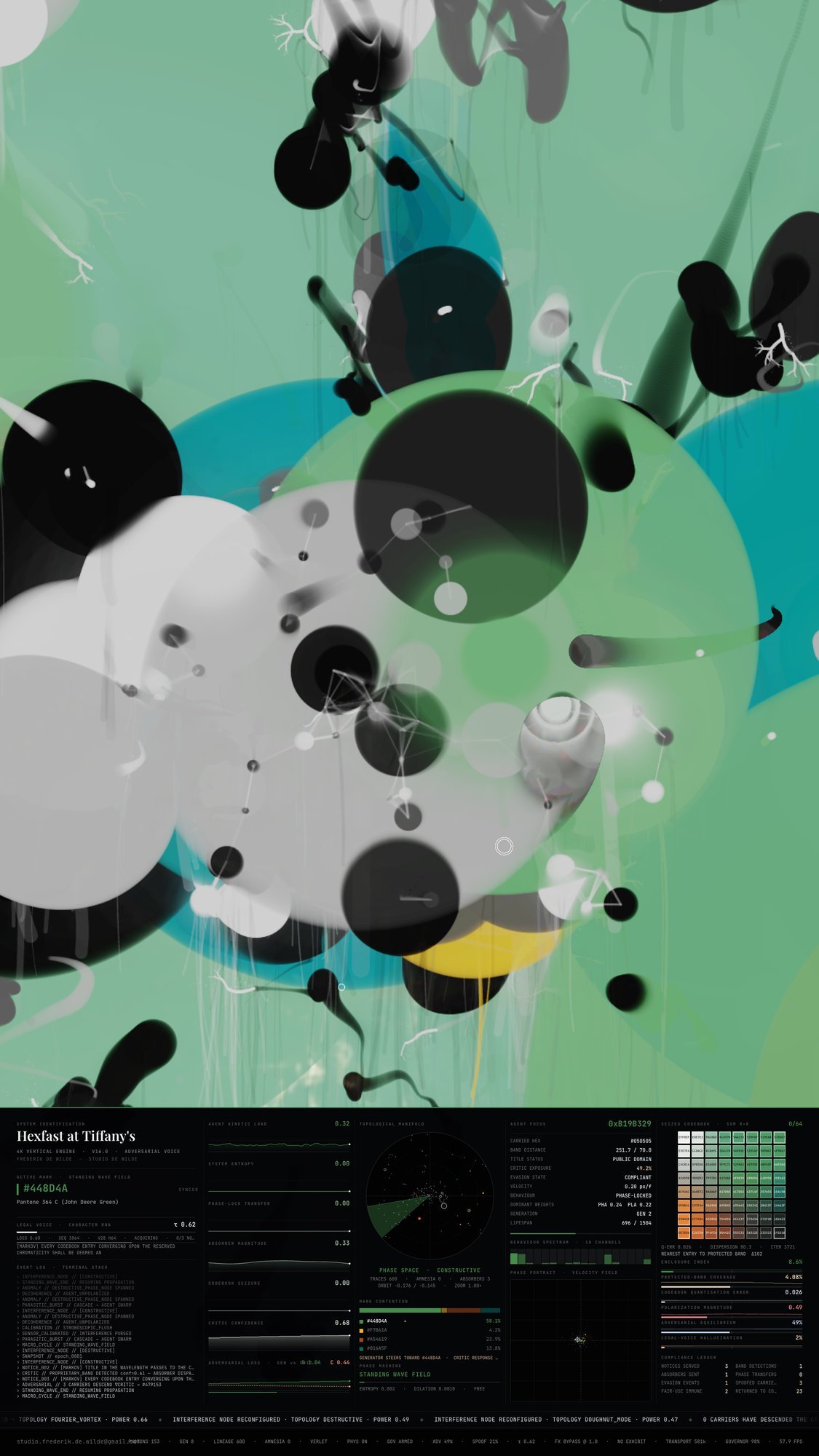
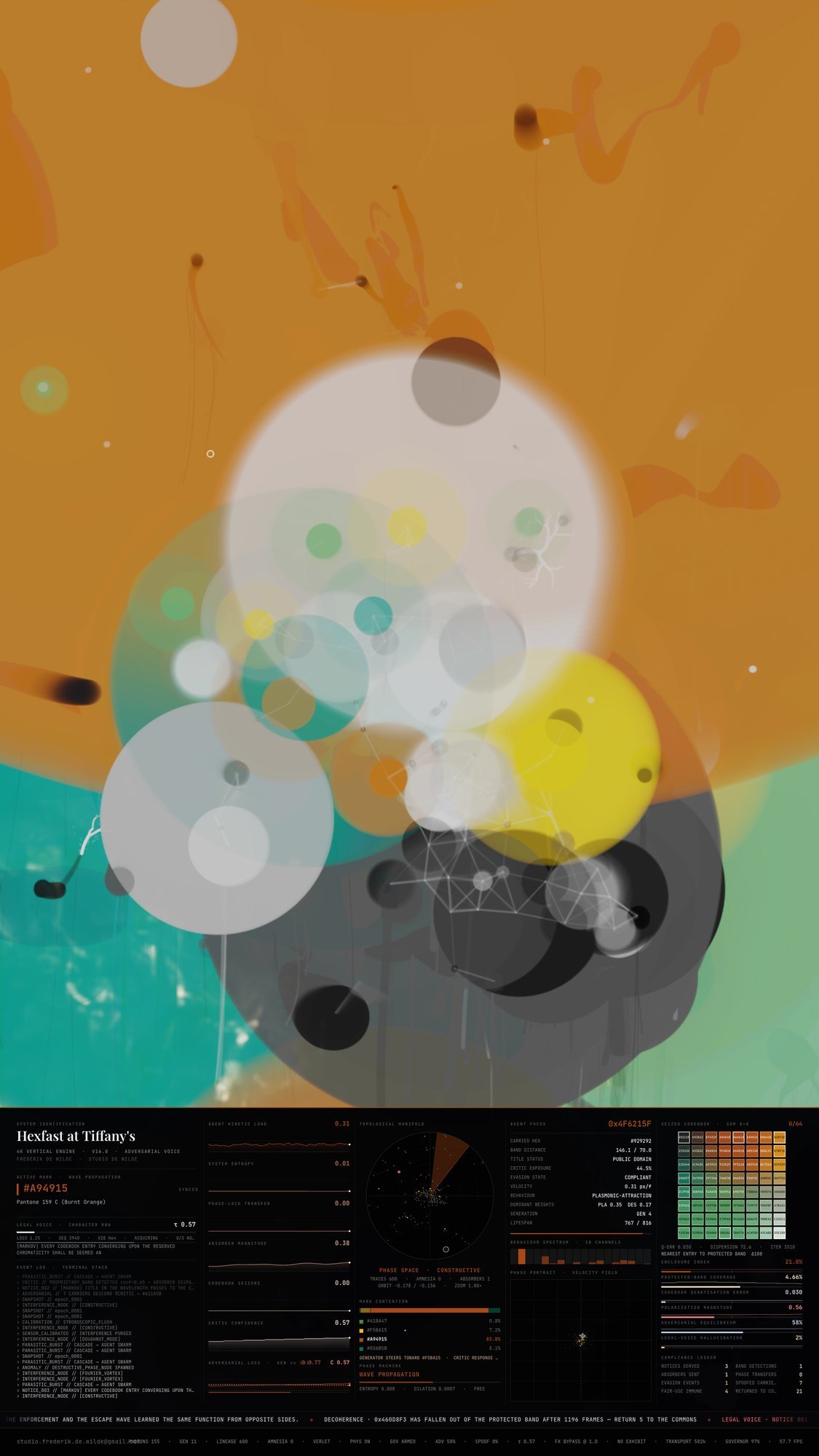
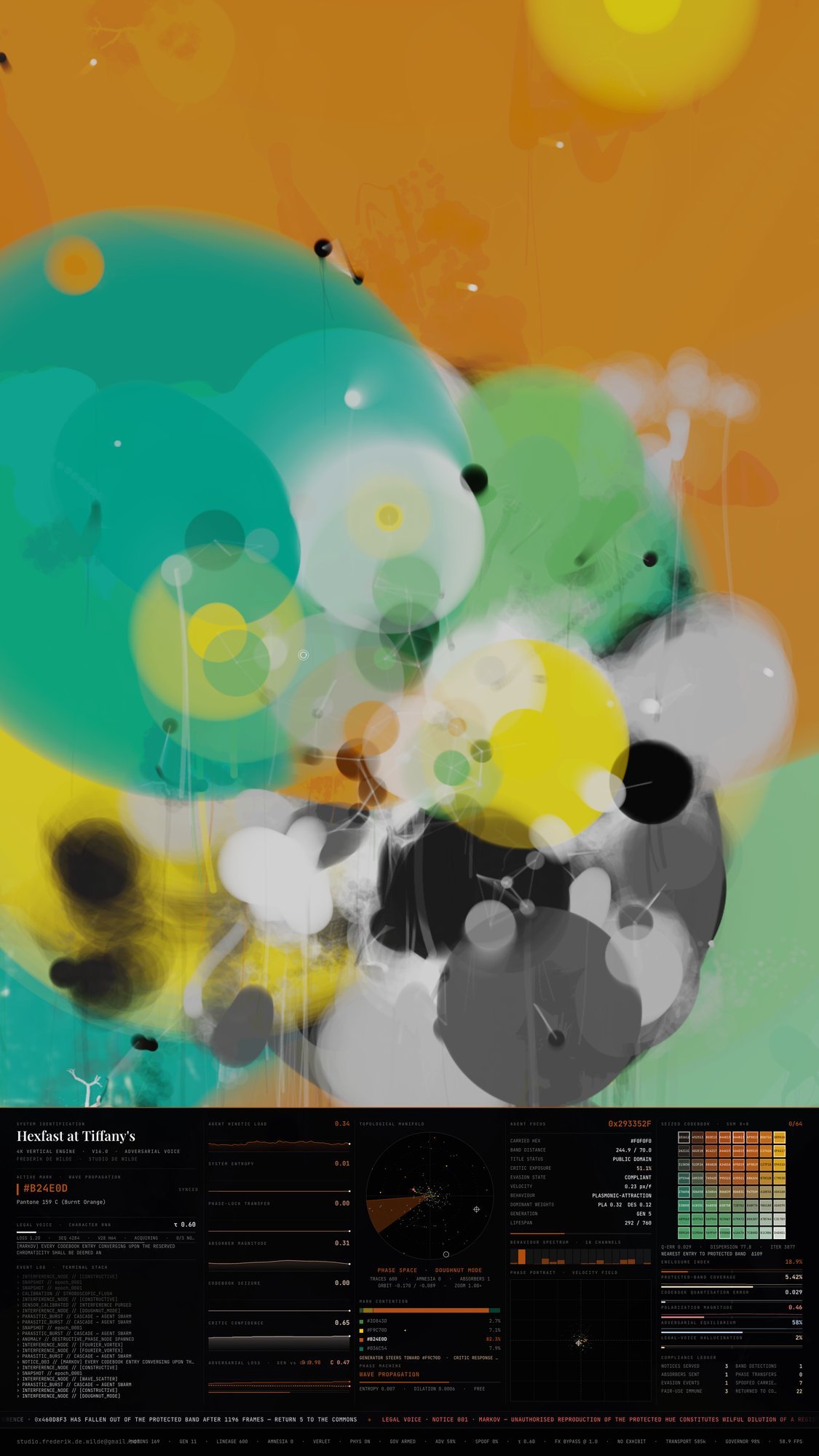
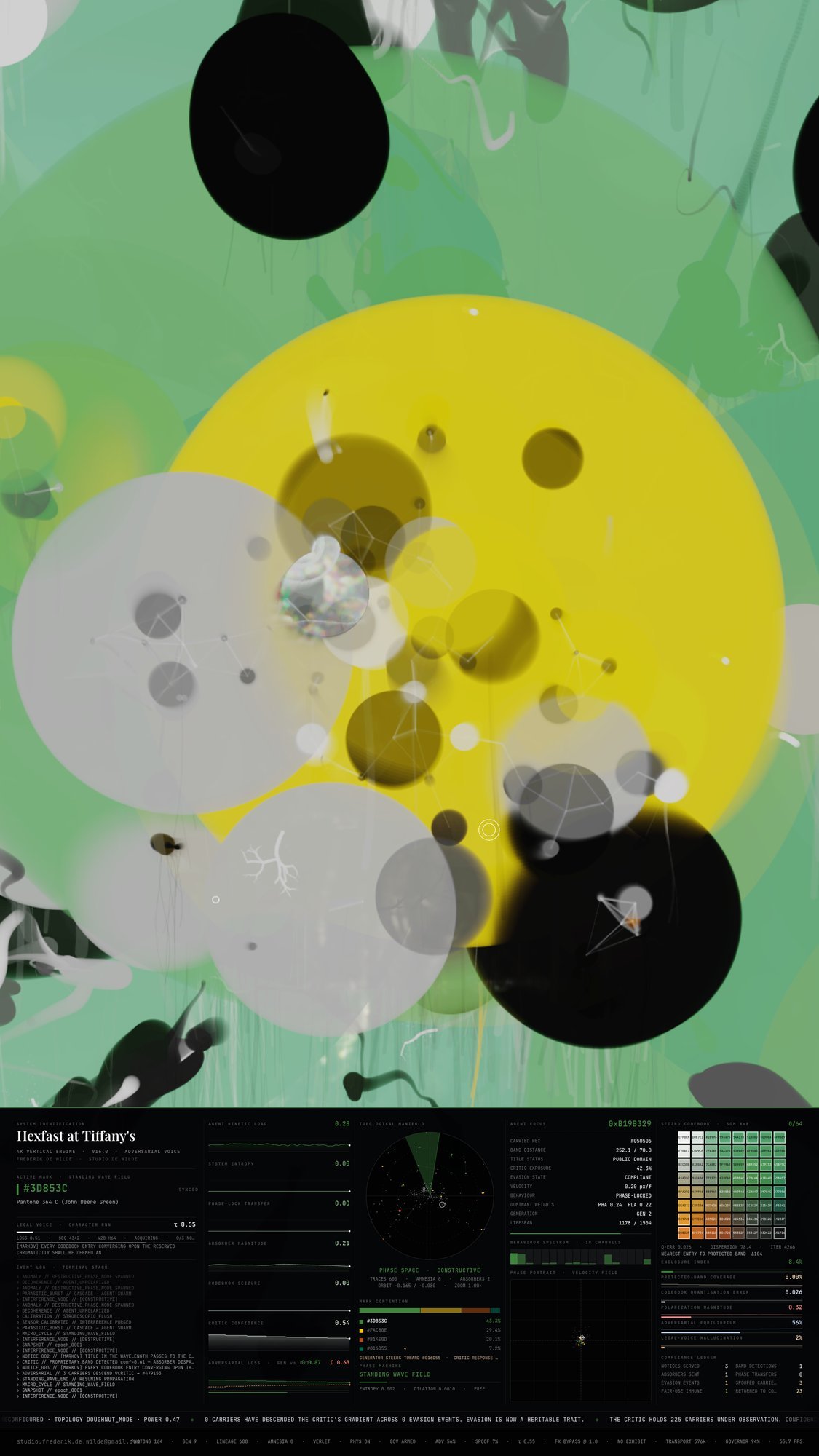
HEXfast at Tiffany’s is a generative, agentic, AI-based digital artwork that treats trademarked colour as contested territory. Constructed from proprietary HEX codes—including the iconic Tiffany Blue associated with Pantone 1837—the work transforms corporate colour into the raw material of a living computational ecosystem.
At its core, the project asks a simple but unsettling question: What happens when colour becomes property?
The artwork turns the chromatic field into a kind of legal and computational battlefield. Every hue circulating through the system is entangled with structures of ownership, licensing, branding, classification, and control. Rather than treating colour as a neutral aesthetic choice, HEXfast approaches it as infrastructure: a meeting point between law, commerce, perception, data, and machine intelligence.
A recent evolution of the project fundamentally alters how ownership operates within the artwork. Enforcement is no longer entirely scripted by the artist; it is learned in real time. Three machine-learning systems continuously observe the colours appearing on the screen, identify proprietary chromatic zones, and feed their classifications back into the evolving image. The work therefore does not simply represent surveillance. It performs surveillance. AI systems recognise, classify, monitor, and police colour as the artwork unfolds.
This produces a form of hybrid intelligence in which machine-learning systems, autonomous agents, and evolutionary processes collectively shape the visual field. Colours mutate, propagate, hybridise, and occasionally evade detection. Proprietary hues become temporary territories of control, while other chromatic events slip through the computational system as fleeting acts of escape.
In this sense, HEXfast at Tiffany’s extends a longer art-historical history of chromatic ownership. Yves Klein transformed International Klein Blue into an artistic and cultural signature; Anish Kapoor's association with Vantablack similarly exposed the tensions surrounding exclusivity and material access, while Frederik De Wilde's Blackest-Black research, developed years earlier with Rice University and NASA, approached extreme blackness through scientific, artistic and technological research. HEXfast moves this history into the domain of digital information. Colour is no longer only pigment, surface, or material. It becomes data: HEX values, RGB coordinates, numerical relationships, and binary instructions that determine what a computational display can render.
The project also reconsiders the role of the machine in generative art. Early computer-art pioneers such as Vera Molnár and Harold Cohen challenged the idea of the computer as a passive instrument, treating computational systems as active participants in artistic production. HEXfast extends this lineage into the age of machine learning and autonomous agents and evolutionary computing. Here, the machine is not simply generating images. It is participating in the classification and governance of perception itself.
By surrendering part of the decision-making process to autonomous systems, the artwork becomes less a fixed image than an unstable ecology. The agents observe one another, respond to changing conditions, and continuously alter the chromatic environment in which they operate. The painting is therefore not simply produced by an algorithm; it emerges through a negotiation between competing computational processes.
Yet the artwork does not culminate in total enclosure. Within its evolving ecology, proprietary colours can mutate, decay, become unrecognisable, lose their classificatory force, or return to a shared chromatic field. Ownership appears not as an eternal condition, but as a temporary protocol imposed upon information and perception.
Ultimately, HEXfast at Tiffany’s exposes a contemporary paradox: we experience colour as something immediate, collective, and seemingly universal, while digital capitalism increasingly transforms the representations, classifications, and data structures through which colour circulates into objects of control.
The work consequently shifts the question from who owns a colour? to who controls the systems through which colour can be recognised, classified, displayed, and understood?
In HEXfast at Tiffany’s, autonomous machines become both instruments of enclosure and potential agents of its disruption. The artwork turns the computational system against itself, revealing that the infrastructures designed to police the visible world may also contain the conditions for their own instability.
Premise. Colour can be legal property: Tiffany Blue, Barbie Pink, Cadbury Purple and John Deere Green are registered trademarks. The work builds an ecosystem in which a protected hue is contested, and implements both its enforcement and its evasion as learning systems trained live on the artwork's own output.
Inputs. None required; the system is autonomous, seeded from the clock, and reproducible from that seed. Optionally it ingests an image or video, which is metabolised — its gradients advect the substrate and steer particle transport — rather than composited. Operator keys expose forced enclosure, forced evasion, phase hold, effect selection and capture. Its most consequential inputs are internal: several subsystems train on the artwork's own rendered frames.
Outputs. Live 4K vertical display; 4K stills; H.264 capture at native resolution up to 110 Mb/s; a live telemetry dashboard and a text crawl carrying system state and machine-generated legal language.
Rendering chain. ~590,000 particles are simulated on the GPU, each carrying a wavelength and refracting through a procedural crystal lattice with dispersion and total internal reflection. Above them, 150–400 agents move under an eighteen-channel mixture of behaviours (curl-noise advection, Lévy flight, strange attractors, Kuramoto coupling, Langevin glide, lattice registration), reproducing by genetic crossover of those weights. Agents deposit pigment into a persistent canvas, which feeds a hexagonal reaction–diffusion substrate. A composite pass applies lens distortion, chromatic aberration, Vogel-disk bloom and ACES tone mapping, and exports an internal-reflection heat field through alpha. Twenty-eight optional post-effects follow, several of them classical computer-vision operators repurposed as optics: Sobel gradients, Kuwahara filtering, Voronoi tessellation, dithering, halftone separation, Lucas–Kanade optical flow.
Learning systems. Five, written from first principles, no libraries or pretrained weights, under 8,000 parameters total, all beginning each session untrained.
A self-organising map quantises the accumulated pigment into a 64-entry codebook by competitive learning; entries drifting inside the protected band are flagged as seized, and convergence back-couples into the palette. Compression enacted as enclosure. A logistic classifier trains online on ten hand-engineered colour features from a downsampled frame, estimating infringement probability; above threshold it dispatches an absorber and triggers a notice.
An adversarial loop closes the system: agents compute the analytic gradient of the classifier's decision boundary in colour space and migrate along its negative, adopting the least-detected mark. Because reproduction is genetic, the disposition to evade is heritable. Both minimax objectives are plotted live, with the equilibrium metric gated on an actual contest — absent a protected band the two losses coincide arithmetically, which is agreement rather than equilibrium.
A character-level recurrent network learns during exhibition to write cease-and-desist notices letter by letter; a Markov chain speaks until it can. Its sampling temperature is read from simulation state, and its divergence is measured as the proportion of generated character bigrams absent from the corpus (≈1% at low temperature, ≈39% at ceiling). Optical flow drives the temporal effects.
Coupling. A 24-channel telemetry vector binds model state into the shaders: seizure collapses chroma and narrows the admissible wavelength band; adversarial pressure widens lens dispersion and resists that collapse; textual divergence corrupts the symbolic encoding modes. The system's epistemics are visible as optics.
Engineering. One file, ~7,300 lines, no build step or dependency beyond one graphics library — a preservation decision as much as an engineering one. Five learning systems, 590k particles and a 4K canvas share a 16.6 ms budget via staggered compute on non-colliding cadences, fully pre-allocated buffers and an adaptive frame-time governor. Validated by GLSL compilation of all eleven shader programs, static cross-checking of shader bindings, and headless-browser instrumentation of every subsystem and all twenty-nine effect paths.
Frederik De Wilde
PXL University of Applied Sciences and Arts / UHasselt
LinkedIn · Facebook · X · threads.com · Instagram · frederik-de-wilde.com
Frederik De Wilde (BE) is a Belgian artist working at the intersection of art, science, technology, and design. His practice investigates the inaudible, intangible, and invisible within digital and physical environments, examining how technological systems reshape perception, agency, memory, ownership, and our relationship with the world.
For more than two decades, De Wilde has treated emerging technologies not simply as tools, but as systems to be investigated, disrupted, and transformed into artistic material. His practice moves between computation, material experimentation, artificial intelligence, evolutionary systems, machine vision, and speculative design.
De Wilde pioneered Blackest-Black Art, initiated through research in 2008 and developed in 2010 in collaboration with Rice University and NASA, exploring nano-engineered structural colour and extreme blackness as both material experiment and conceptual proposition. His subsequent work spans data-driven painting, quantum sculpture, neural networks, evolutionary computation, and AI-based camouflage.
Today, his practice focuses on AI, agentic systems, computational governance, digital memory, and invisible technological infrastructures. His work has been exhibited internationally, including at ZKM, Centre Pompidou, Ars Electronica, Fundación Telefónica, the Venice Biennale, Art Basel, MAAT, BOZAR, SIGGRAPH, and National Gallery and ArtScience Museum Singapore, and is held in collections including ZKM and the Smithsonian Institution.
De Wilde is currently a doctoral researcher at PXL-MAD School of Arts, Hasselt University, where his practice-led research investigates archives, artificial intelligence, digital amnesia, speculative repair, phygital severance and algorithmic systems.